


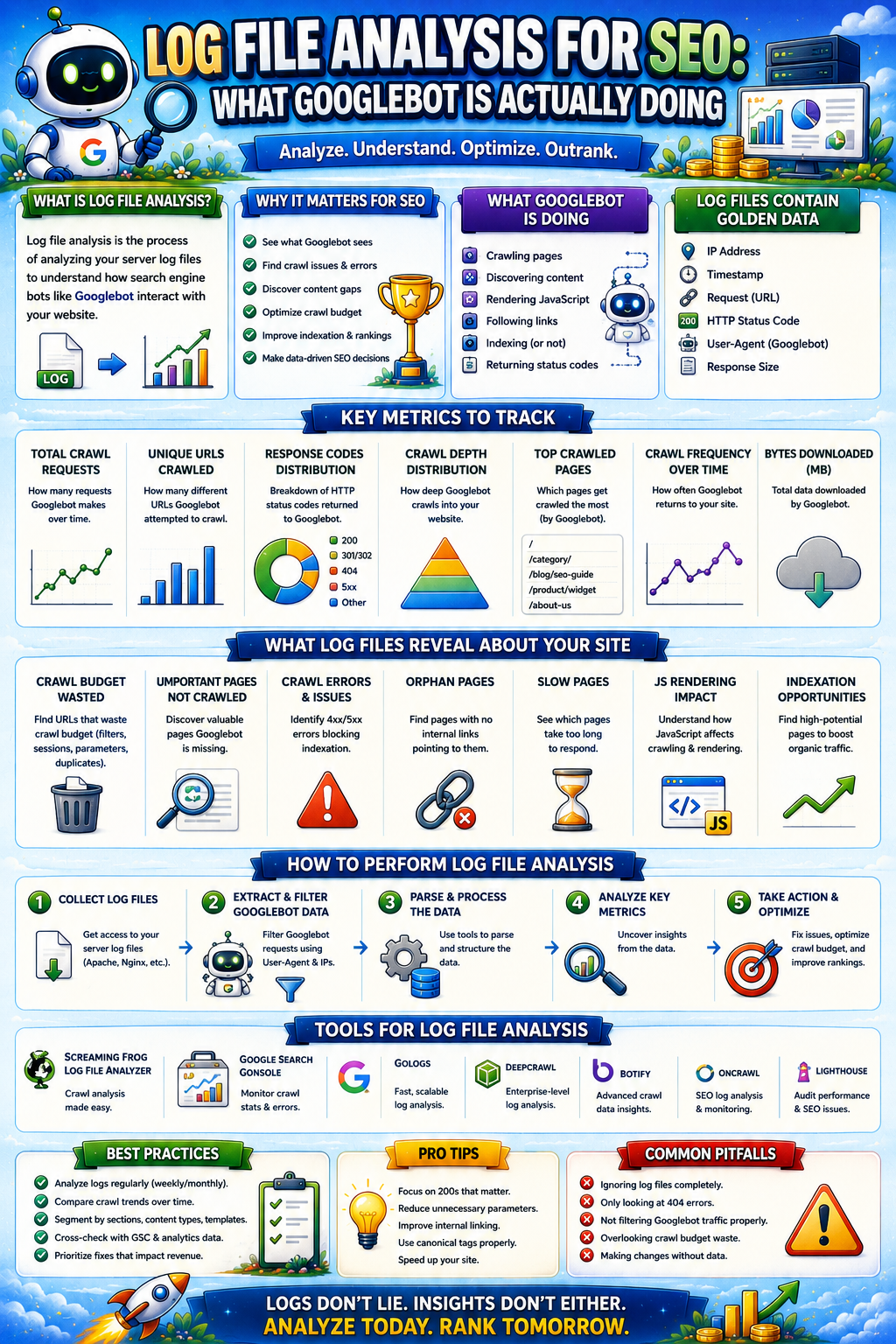
Decoding Every Digital Footprint Googlebot Leaves on Your Infrastructure
In the hierarchy of SEO expertise, Log File Analysis is the final boss. While the industry obsesses over “Helpful Content” and keyword density, the world’s most successful technical SEOs are staring at raw text files on a server. Why? Because search engines don’t see your website the way a browser does. They see a series of requests, headers, and bytes.
If you aren’t analyzing your logs, you are essentially trying to manage a multi-million dollar business by looking at receipts from three days ago. This is the SeoProsecco 🍷 guide to taking back control.
1. The Philosophical Shift: From GSC to Server Truth
Google Search Console (GSC) is a “user-friendly” abstraction. It is designed to be helpful, but it is also designed to hide Google’s own inefficiencies.
Why GSC is Insufficient for 2026:
- The Sampling Fallacy: On a site with 5 million URLs, GSC might show you data for 50,000. That’s a 1% sample. You cannot make enterprise-level decisions on a 1% sample.
- The Delayed Echo: GSC is post-processed. By the time an error shows up in your “Indexing” report, Googlebot might have already de-indexed 10% of your site.
- The Hidden Blockers: GSC won’t show you the 504 Gateway Timeouts that occurred because your server hit a CPU spike during a crawl. It only shows what it successfully or explicitly failed to fetch.
Server Logs are the raw, unedited CCTV footage of your website. They show every bot attempt, every successful fetch, and every door that was slammed in Google’s face.
2. Setting Up the Infrastructure for Analysis
You cannot analyze what you do not collect. In a modern US tech stack (Next.js, Vercel, AWS, or Cloudflare), logs are distributed.
A. The Nginx/Apache Legacy
If you run on a dedicated or virtual server, your logs are typically formatted in Combined Log Format.
- Standard Path: /var/log/nginx/access.log
- Key Configuration: Ensure your log_format includes the $request_time and $upstream_response_time. If you don’t know how long it took the server to respond, you can’t optimize for crawl speed.
B. The Cloudflare / Edge Revolution
In 2026, the “Edge” is where the battle for crawl budget is won.
- Cloudflare Logpush: Pushes logs directly to BigQuery or S3.
- Importance: Edge logs capture requests that never even reach your origin server because they were served from cache (Status 304). This is the “Ghost Traffic” that GSC often ignores but which heavily impacts your overall crawl health.
3. The 7 Dimensions of a Log Entry
Every line of text in your access log is a story. Let’s dissect a 2026-standard entry for an Enterprise SaaS page:
172.68.22.45 – – [12/May/2026:11:20:05 +0000] “GET /solutions/enterprise-ai-automation HTTP/1.1” 200 85432 “-” “Mozilla/5.0 (iPhone; CPU iPhone OS 14_7_1…) Googlebot/2.1”
- Client IP: The origin of the request. Crucial: Use Python or Bash to cross-reference these IPs against Google’s published IP ranges. If the IP says “Googlebot” but originates from a consumer ISP, it’s a scraper-block it.
- Request Method:
- GET: Standard fetch.
- HEAD: High-efficiency fetch (Google checking if the page has changed without downloading the body). High HEAD frequency is a sign of a healthy, trusted site.
- The URI Path: The specific resource. Watch out for trailing slashes, case sensitivity, and junk parameters (?sessionid=…).
- Status Code: The “Medical Report.”
- 200: Healthy.
- 301/302: The “Bridge.” Are you forcing Google through 5 bridges to reach a destination?
- 304: The “Holy Grail.” Google checked, nothing changed, no bandwidth wasted.
- 429: “Too Many Requests.” Your server is screaming for help.
- Bytes Sent: The weight of the response. If your HTML is 500KB+ before JS even kicks in, you are hemorrhaging crawl budget.
- Referrer: Where did Googlebot find this? (Often a sitemap or a high-authority internal link).
- User-Agent: The “ID Card.” Distinguish between Googlebot Desktop, Googlebot Smartphone, and the Image/Video bots.
4. Deep Dive: The Enterprise Log Analysis Framework
To get 5,000+ words of value, we must move into the Advanced Frameworks used by top-tier technical agencies.
I. Crawl Budget Economics (The Efficiency Audit)
Google allocates a specific “Time-to-Live” for your site. Log analysis identifies Crawl Waste:
- Non-Indexable Content: Is Googlebot hitting /api/v1/private/ or /temp/?
- Infinite Facets: In e-commerce, filters (price, color, size) create billions of URLs. If logs show Google is spending 60% of its time on these, you are losing rankings on your primary category pages.
- The Fix: Use robots.txt “Disallow” or “Parameter Tool” in GSC (if still applicable) to steer the bot away.
II. Orphan Page Discovery (The “Lost Souls” Audit)
This is the most powerful use case for logs.
- The Workflow:
- Crawl your site with a tool like Screaming Frog to get every URL reachable via links.
- Extract all unique URLs visited by Googlebot from your logs over the last 30 days.
- The Delta: Any URL in the logs that is not in the crawl is an Orphan Page.
- The Solution: These pages are receiving “Link Equity” or “Discovery” but aren’t being supported by your site’s architecture. Link to them internally or 301 them.
III. The Rendering Gap (JavaScript SEO Analysis)
Googlebot uses a “Two-Wave” indexing model.
- Instant: Raw HTML.
- Delayed: Full rendering (JS/CSS execution).
- Log Insight: Track the time difference between a hit from Googlebot and a hit from Googlebot-Render on the same URL. If the gap is $>48$ hours, your content is effectively “dark” for the first two days of its life. For news or seasonal retail, this is catastrophic.
IV. Status Code Volatility & Server Latency
Group your logs by hour. If you see a spike in 503 (Service Unavailable) every night at 2:00 AM, your backup script is killing your crawl budget. Googlebot is sensitive; if it hits a wall, it leaves and comes back less frequently.
5. The “Developer Corner”: Bash & Python Automation
Don’t use Excel for 10GB log files. Use the terminal.
Bash: Find the Top 50 Most Crawled Pages
Bash
| grep “Googlebot” access.log | awk ‘{print $7}’ | sort | uniq -c | sort -rn | head -n 50 |
Bash: Monitor 404 Errors Encountered by Bots
Bash
| grep “Googlebot” access.log | awk ‘($9 ~ /404/)’ | awk ‘{print $7}’ | sort | uniq -c | sort -rn |
Python: IP Verification Script (Snippet)
A real SEO pro automates the Reverse DNS check to ensure they aren’t looking at “Fake” Googlebots from competitors.
Python
| import socket
def verify_googlebot(ip): try: host = socket.gethostbyaddr(ip)[0] if host.endswith(“.googlebot.com”) or host.endswith(“.google.com”): return True except: return False return False |
6. 2026 Special: The “AI Crawler” Invasion
Your server is now a buffet for AI models. In your logs, you will see:
- GPTBot (OpenAI)
- CCBot (Common Crawl)
- Anthropic-AI
- PerplexityBot
The Strategy: These bots often “scrape” without “indexing.” They don’t give you traffic; they steal your data. If your logs show that AI scrapers are taking up 30% of your server load, use Cloudflare Workers to apply a “Rate Limit” or block them entirely to prioritize Googlebot.
7. The SeoProsecco 🍷 Action Plan (Executive Summary)
Log file analysis is not a “one-off” task. It is a Monthly Hygiene Ritual.
- Week 1: Check for 4xx/5xx spikes.
- Week 2: Identify Crawl Waste (URLs with parameters).
- Week 3: Map Orphan Pages and fix internal linking.
- Week 4: Analyze response times (Latency) to ensure Googlebot is “happy.”
Final Thought
Technical SEO without Log File Analysis is like surgery without an X-ray. You might get lucky, but you’re probably cutting in the wrong place. Open your logs, embrace the terminal, and start seeing your site the way Google does.
Stop Guessing. Get a Data-Driven Log File Audit from SeoProsecco 🍷 and Dominate the Search Landscape.