


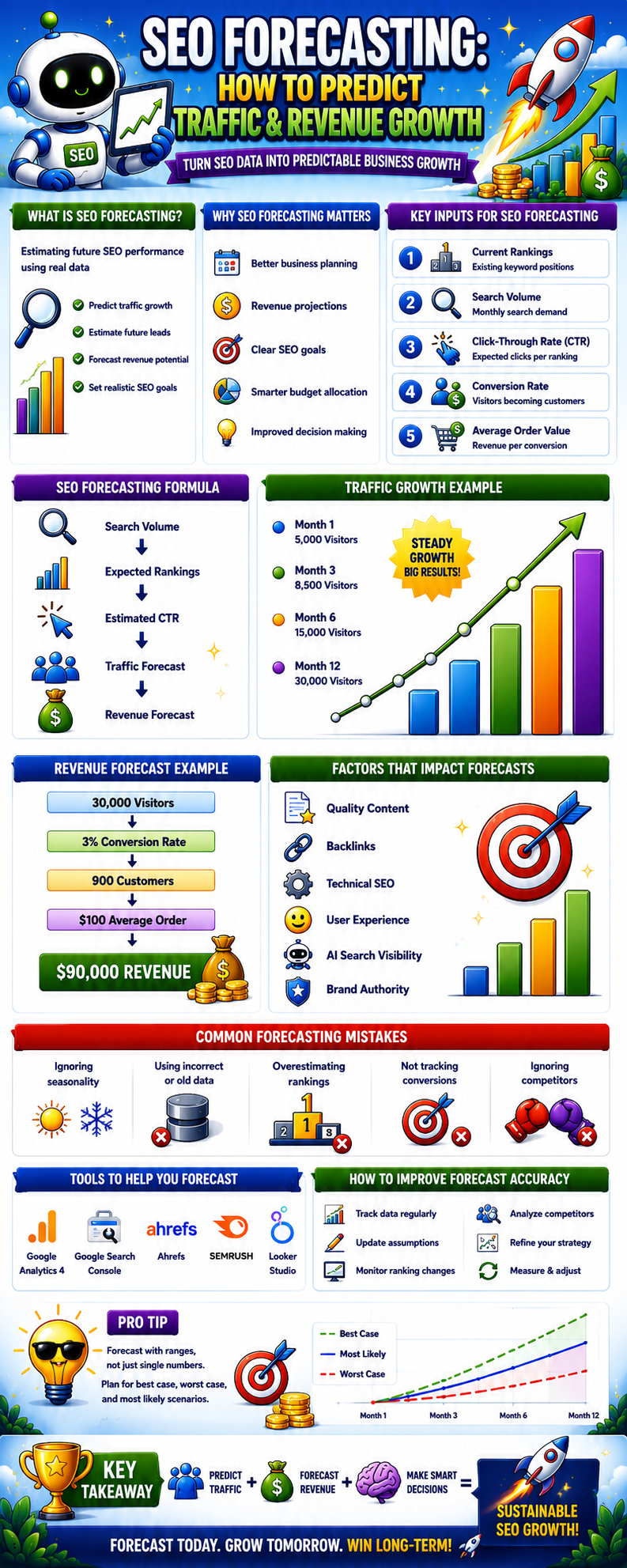
If you’ve ever been asked “when will SEO start working?” and didn’t have a confident answer, you’re not alone. Most SEO professionals can describe what they’re doing – but struggle to show what it will deliver, and when.
That’s exactly what SEO forecasting solves.
SEO forecasting is the practice of using historical data, keyword metrics, and conversion benchmarks to project future organic traffic and revenue growth. It turns SEO from an activity into an investment with a measurable expected return – and it gives you something concrete to show clients, executives, and stakeholders before results arrive.
In this guide, you’ll get a step-by-step methodology, real formulas with worked examples, and a breakdown of the tools that make forecasting faster and more accurate.
What Is SEO Forecasting?
SEO forecasting is the process of estimating how much organic traffic and revenue your website is likely to generate over a future period, based on data you already have.
It is not a guarantee. No one can promise exactly where a page will rank six months from now. What forecasting gives you is a data-driven estimate – built on search volume, CTR benchmarks, ranking projections, and your own conversion data – that sets realistic expectations and makes SEO strategy easier to justify.
Every SEO forecast produces two core outputs:
- Traffic forecast – the number of organic visits you can expect over a defined period
- Revenue forecast – the monetary value of that traffic based on your conversion rate and average deal size
Done well, SEO forecasting changes the conversation from “trust us, it’ll work” to “here’s what the data suggests, here’s our methodology, and here’s how we’ll measure it.”
Why SEO Forecasting Matters for Your Business
For Agencies and Consultants
Forecasting builds client trust before results arrive. Clients who understand what to expect – and why the first three months may look slow – are far less likely to cancel a campaign prematurely. A well-presented forecast also differentiates your agency from competitors who can only say “it depends.”
For In-House SEO Teams
When budget approval requires a business case, “we plan to improve rankings” rarely gets sign-off. A projected $180,000 annual revenue increase from organic search – with assumptions clearly stated – is a different conversation entirely. Forecasting gives in-house teams the language of the boardroom, not just the marketing department.
For E-Commerce and SaaS Businesses
Forecasting connects SEO activity directly to business outcomes: units sold, trial signups, monthly recurring revenue. This makes SEO a strategic investment rather than a line item that gets cut when budgets tighten.
Organic search consistently ranks as one of the largest sources of website traffic across industries. If your business is not investing in SEO with a clear projection of returns, you are making a budget decision without the full picture.
What Data Do You Need to Build an SEO Forecast?
Accurate forecasting starts with the right inputs. Before building any projection, gather the following:
- Current organic traffic – pull 12 months of data from Google Search Console to establish your baseline and identify seasonality patterns
- Target keyword list – the keywords you plan to rank for, each with monthly search volume from Ahrefs, SEMrush, or Google Keyword Planner
- Current keyword rankings – your starting positions for each target keyword, so you can project realistic improvements
- CTR benchmarks by SERP position – average click-through rates for positions 1 through 10 (a reference table is provided in the next section)
- Website conversion rate – the percentage of organic visitors who convert to a lead or sale, pulled from your own Google Analytics data
- Average order value or deal size – to translate projected traffic into projected revenue
The more historical data you have, the more reliable your forecast. A website with two years of Search Console history can build a much more grounded projection than a site launched six months ago – which will require more conservative assumptions and wider scenario ranges.
How to Calculate Your SEO Traffic Forecast – Step by Step
This is the core of the methodology. Work through each step in order, using your own data in place of the example figures.
Step 1 – Estimate Ranking Improvements
Start with your current keyword rankings and project where each keyword could realistically rank after six to twelve months of focused SEO work.
Be conservative. A keyword sitting in position 18 does not jump to position 1 in three months unless competition is extremely low. A realistic projection for a mid-authority domain might look like this:
- Position 18 → Position 8 after 3 months
- Position 8 → Position 4 after 6 months
- Position 4 → Position 2 after 12 months
Your projections should account for keyword difficulty, domain authority relative to competitors, and the quality of content you plan to produce. Do not forecast position 1 for every keyword – it will destroy your credibility when actuals come in lower.
Step 2 – Apply CTR by Position
Once you have projected positions, apply click-through rate benchmarks to estimate how many clicks each position generates.
Use the following reference values as a starting point – but verify against a current CTR study before publishing, as these figures shift over time:
| SERP Position | Average CTR |
| 1 | 27–28% |
| 2 | 15% |
| 3 | 11% |
| 4 | 8% |
| 5 | 7% |
| 6–7 | 5% |
| 8–10 | 3–4% |
The formula:
Projected Monthly Traffic (per keyword) = Monthly Search Volume × Expected CTR
Worked example: A keyword with 2,000 monthly searches, projected to rank in position 3, generates approximately: 2,000 × 11% = 220 visits per month
Step 3 – Aggregate Across Your Keyword Set
Repeat the calculation from Step 2 for every keyword on your target list. Sum the results to get your total projected monthly organic traffic.
Build this in a spreadsheet with one row per keyword. Columns should include: keyword, monthly search volume, current position, projected position, expected CTR, and projected monthly visits. A final sum row gives you your total traffic forecast.
If you work with a list of 50 target keywords and the average projection is 90 visits per keyword per month, your total forecast is approximately 4,500 monthly organic visits – up from whatever your current baseline is.
Step 4 – Apply Conversion Rate and Revenue Metrics
Once you have a traffic projection, apply your conversion data to estimate revenue.
The formula:
Projected Monthly Revenue = Projected Traffic × Conversion Rate × Average Order Value
Worked example:
- Projected monthly organic traffic: 5,000 visits
- Website conversion rate: 2%
- Average order value: $150
- Projected monthly revenue: 5,000 × 2% × $150 = $15,000
Always use your own conversion rate data from Google Analytics – not industry averages. Industry benchmarks vary widely and will either overstate or understate your results. If you do not yet have reliable conversion data, flag this clearly as an assumption in your forecast and use a conservative figure.
SEO Forecasting Models – Which Approach Should You Use?
There is no single right way to build an SEO forecast. The best model depends on how much data you have and what you are trying to show.
Keyword-Level Forecasting
The method described above. Best for campaigns with a defined target keyword list. Most granular and accurate when search volume and ranking data are available. This is the standard approach for agency client reporting and campaign planning.
Top-Down Traffic Forecasting
Best for established websites with at least 12 months of Search Console history. Instead of building up from individual keywords, this model projects future traffic based on historical growth trends. Useful for presenting 12-month growth curves to executives who want a single number rather than a keyword-by-keyword breakdown.
Opportunity-Based Forecasting
Best for new campaigns or competitive landscape analysis. Estimates the total traffic available if your site ranked in the top three positions for all target keywords, then applies a realistic capture rate – for example, 30% of total available traffic. Good for showing upside potential when pitching a new SEO engagement.
A note on all three models: Present forecasts as ranges – conservative, base case, and optimistic – rather than single-point estimates. A single number implies false precision. A range demonstrates that you understand the variables involved.
Tools That Make SEO Forecasting Faster and More Accurate
You do not need expensive software to build a reliable forecast. Here are the tools that matter most:
- Google Search Console – your primary data source for current organic performance, impressions, clicks, and average position by keyword
- Ahrefs or SEMrush – keyword search volume, keyword difficulty scores, and competitor traffic estimates; either works, choose based on your existing subscription
- Google Keyword Planner – free keyword volume data, accessible with any Google Ads account; less precise than paid tools but adequate for initial forecasts
- Google Sheets or Excel – the actual forecasting engine; a well-structured spreadsheet with the formulas from this guide is all you need to build a professional forecast
- Google Looker Studio – for visualizing forecast vs. actual traffic over time; particularly useful for client-facing dashboards where you compare projected against real monthly performance
A solid forecast is possible with free tools and a structured spreadsheet. Paid tools accelerate the data-gathering stage, but they do not change the underlying methodology.
How Accurate Are SEO Forecasts?
Honest answer: forecasts are directional, not precise.
Short-term forecasts covering three to six months carry significant uncertainty because ranking movements are unpredictable in the near term. A 12-month forecast built on solid historical data and realistic assumptions is considerably more reliable – but still subject to variance from algorithm updates, competitive shifts, and changes in search behavior.
Here is what forecasting accuracy looks like in practice:
- A forecast built on 12 months of Search Console data and conservative CTR assumptions will typically land within 20–30% of actual results over a 12-month period
- A forecast built on limited data and optimistic assumptions can be off by 50% or more
To protect your credibility, follow these rules:
- Always present three scenarios: conservative, base, and optimistic
- State your assumptions explicitly – conversion rate, CTR benchmarks, ranking timeline
- Update the forecast quarterly as real data replaces projected figures
- Never present a forecast as a guarantee – present it as a methodology with stated inputs
The goal is not perfection. The goal is a structured, honest, data-backed estimate that sets appropriate expectations and gives the campaign a clear success benchmark.
How to Present an SEO Forecast to Clients or Stakeholders
Building the forecast is only half the job. Presenting it effectively is what drives decisions.
Lead with business outcomes, not SEO metrics. A CFO does not care about position 4. They care about pipeline. Open your forecast presentation with projected revenue or leads, then work backward to explain how SEO drives those numbers.
Show three scenarios. Conservative, base, and optimistic. This demonstrates analytical rigor and protects you when results land somewhere in the middle – which they usually do.
Include a 12-month timeline chart. A visual showing projected monthly traffic growth from month one to month twelve is far more persuasive than a table of numbers. It also makes the slow early months feel expected rather than alarming.
Be transparent about assumptions. If the forecast assumes a 2% conversion rate and $120 average order value, say so on the slide. Stakeholders who understand your inputs are far less likely to challenge your conclusions.
Commit to a quarterly review cadence. Forecasts are living documents. At the end of each quarter, compare projected vs. actual and update the remaining months accordingly. This builds trust over time and demonstrates that your methodology improves with real data.
Common SEO Forecasting Mistakes to Avoid
- Using industry-average conversion rates instead of your own data – this single mistake can make a forecast wildly inaccurate in either direction
- Forecasting position 1 for every target keyword – unrealistic inputs produce unrealistic outputs; when actuals underperform, your credibility takes the hit
- Ignoring seasonality – a business with strong Q4 demand forecasted with flat monthly projections will look like it missed targets in Q1, Q2, and Q3, even if it hit annual numbers
- Treating the forecast as a fixed document – forecasts must be updated quarterly; a 12-month-old forecast that has never been revised is not a forecast, it is a wish
- Mixing branded and non-branded traffic – branded traffic is driven by offline awareness, PR, and word of mouth, not SEO; including it inflates your organic SEO contribution
- Skipping the sanity check – before presenting any forecast, ask: if this came true, would it be believable? If projected revenue triples in four months, something is wrong with the inputs, not the market
Conclusion and Next Steps
SEO forecasting is not a crystal ball. It is a structured methodology that turns SEO strategy into a business case – one built on data, stated assumptions, and realistic projections that can be measured, updated, and defended.
When done well, forecasting changes how stakeholders think about SEO. It becomes less of a speculative expense and more of a calculated investment with a projected return. That shift in perception is often the difference between a campaign that gets full budget and executive support, and one that gets cut at the first sign of slow early progress.
Start with what you have. Build your keyword list, pull your Search Console data, apply the formulas in this guide, and produce your first forecast – even if the inputs are imperfect. A rough forecast updated with real data every quarter is worth far more than a perfect forecast that never gets built.
Ready to see what SEO could realistically deliver for your business? Contact our team for a free SEO forecast and find out exactly how much organic traffic and revenue you could be capturing right now.