


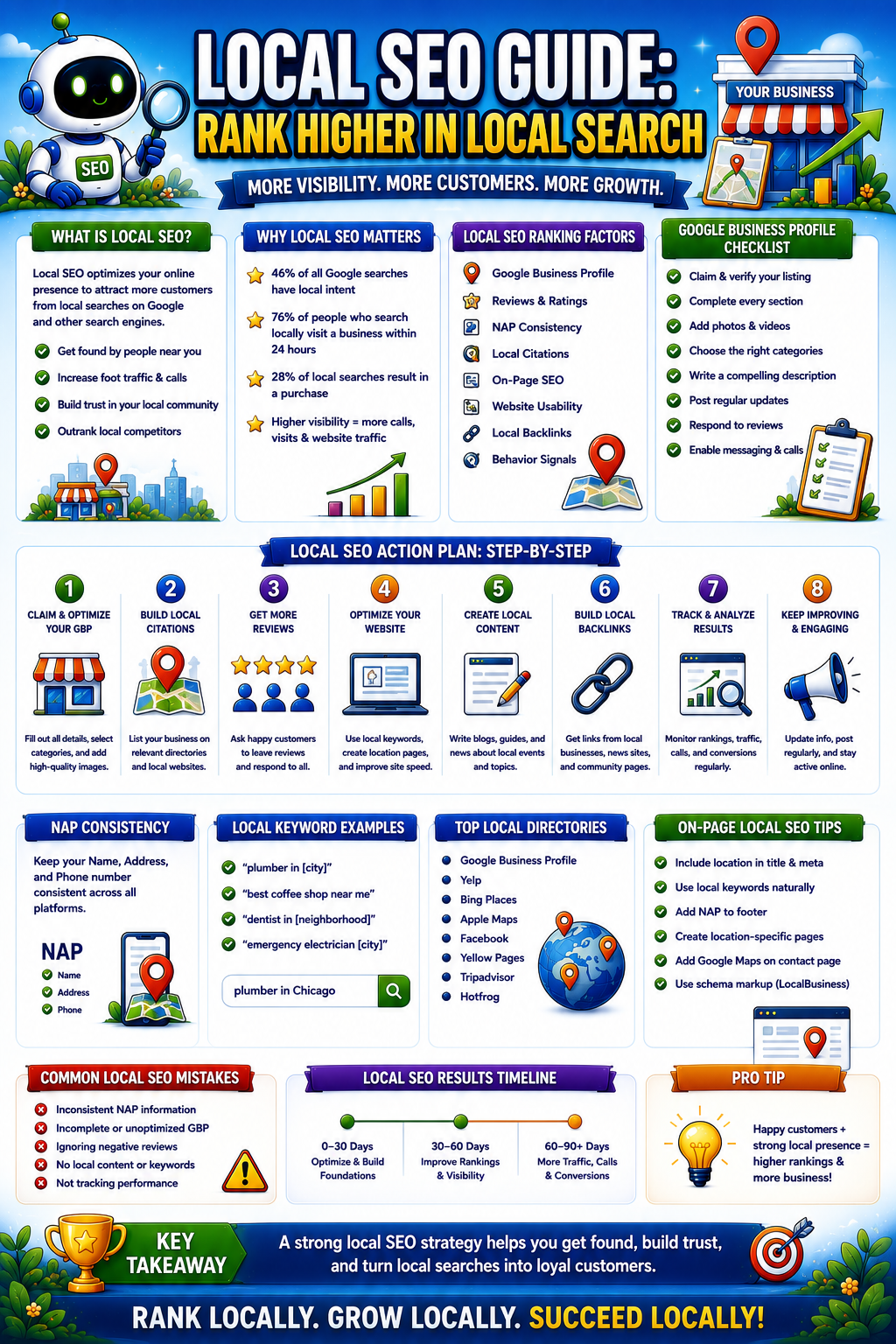
If you run a local business – a dental clinic, a law firm, a hair salon, or a plumbing service – chances are your next customer is already searching for you on Google right now. The question is: are you showing up?
46% of all Google searches have local intent. That means nearly half of everyone searching on Google is looking for something nearby. Local SEO is how you make sure your business appears when those searches happen – in Google Maps, in the local “3-pack,” and in organic results for your city or neighbourhood.
This guide breaks down exactly what local SEO is, what drives your rankings, and what you can do today to start climbing higher in local search.
What Is Local SEO and Why It Matters
Local SEO (local search optimization) is the process of optimising your online presence so your business appears in geographically relevant searches. When someone types “dentist near me” or “best pizza in Kyiv,” Google returns results based on location – and local SEO determines whether your business makes the cut.
This is different from traditional SEO. General SEO targets broad, often national or global audiences. Local SEO targets people in your city, neighbourhood, or service area – people who are ready to call, visit, or book.
Businesses that benefit most from local SEO include:
- Medical and dental practices
- Law firms and accountants
- Restaurants and cafes
- Salons, spas, and gyms
- Plumbers, electricians, and contractors
- Retail stores and boutiques
Consider the difference: a law firm in Chicago targeting “personal injury lawyer” competes nationally. The same firm targeting “personal injury lawyer Chicago Loop” competes locally – and wins more relevant, higher-converting traffic.
Key Factors That Influence Local Rankings
Google uses three core criteria to rank local businesses:
Relevance – Does your business match what the searcher is looking for? A well-optimised Google Business Profile with accurate categories and detailed services signals strong relevance.
Distance – How close is your business to the searcher (or to the location they specified)? While you can’t control your physical address, you can expand your relevance across a wider service area.
Prominence – How well-known and trusted is your business online? This includes your review count, review quality, backlinks, citations, and overall online reputation.
Beyond Google’s three pillars, reviews, citations, and your website’s on-page signals all play important supporting roles.
How to Optimise Your Google Business Profile (GBP)
Your Google Business Profile (formerly Google My Business) is the single most important tool for local SEO. It powers your appearance in Google Maps and the local 3-pack. If you haven’t claimed yours yet, start here.
Step 1: Claim and verify your listing Go to google.com/business and search for your business. Claim it and complete Google’s verification process (usually a postcard, phone call, or video verification).
Step 2: Fill out every field completely
- Business name (exactly as it appears in the real world – no keyword stuffing)
- Address and phone number
- Website URL
- Business hours (and holiday hours)
- Business categories – choose your primary category carefully; it carries the most weight
- Business description – include your primary keywords naturally
Step 3: Add photos regularly Businesses with photos receive significantly more clicks and direction requests. Upload your storefront, interior, team, and products. Aim for at least 10 photos to start, and add new ones monthly.
Step 4: Use the Q&A and Posts features Post weekly updates, offers, or events through GBP Posts. Answer questions in the Q&A section proactively – you can even seed it with your own FAQs.
Step 5: Respond to every review Thank positive reviewers. Address negative ones professionally and constructively. Engagement signals to Google that your listing is active and trustworthy.
NAP Consistency and Local Citations
NAP stands for Name, Address, and Phone number. It sounds simple, but inconsistent NAP information across the web is one of the most common – and damaging – local SEO mistakes.
If your business is listed as “Smith & Sons Plumbing” on your website but “Smith and Sons Plumbing LLC” on Yelp, and your phone number has changed since your old Yellow Pages listing, Google struggles to trust your data. That uncertainty hurts your rankings.
Make sure your NAP is identical everywhere:
- Your website (header, footer, contact page)
- Google Business Profile
- Yelp, TripAdvisor, Apple Maps, Bing Places
- Industry-specific directories
- Social media profiles
Key citation sources to target:
- Yelp
- Yellow Pages / YellowPages.com
- Apple Maps
- Bing Places for Business
- Facebook Business
- Foursquare
- BBB (Better Business Bureau)
- Industry-specific directories (Healthgrades for doctors, Avvo for lawyers, Houzz for contractors, etc.)
Useful tools: Whitespark and Moz Local can audit your existing citations, find inconsistencies, and help you build new ones at scale.
Getting Local Reviews That Drive Trust and Rankings
Reviews are a ranking signal and a conversion tool at the same time. More reviews – especially recent, positive ones – tell Google your business is active and well-regarded. They also tell potential customers the same thing.
Why reviews matter:
- Directly influence your local ranking in Google’s algorithm
- Build trust before a customer ever contacts you
- Improve click-through rates from search results
How to ask for reviews ethically: The best time to ask is right after a positive experience – after a successful appointment, a completed job, or a satisfied purchase. Make it easy: send a direct link to your Google review page via text or email.
You can say something as simple as: “We’d really appreciate it if you left us a quick Google review – it helps local customers find us and takes less than a minute.”
Never offer incentives for reviews. Google explicitly prohibits this and it can get your listing penalised.
Beyond Google, consider platform-specific reviews relevant to your industry – TripAdvisor for hospitality, Healthgrades or Zocdoc for healthcare, Avvo for legal services. Consistency across platforms strengthens your overall prominence.
Local Content and On-Page SEO
Your website needs to speak Google’s language when it comes to location. That means embedding your city, neighbourhood, and service areas into your content – naturally, not awkwardly.
Key on-page optimisation tactics:
- Title tags: Include your service and city. Example: “Family Dentist in Austin, TX | Bright Smile Dental”
- Meta descriptions: Mention your location and a clear value proposition
- H1 and body content: Reference your city and neighbourhood naturally throughout
- Local landing pages: If you serve multiple locations, create a dedicated page for each one with unique, locally relevant content – not just copy-pasted text with the city name swapped
- Embed a Google Map: Add a Google Maps embed to your contact page; it reinforces your location signals
- Schema markup: Add LocalBusiness schema to your website so search engines can clearly read your NAP, hours, and service areas
Avoid thin, duplicate location pages. Google can tell when a page exists purely for SEO with no real value for users.
Local Link Building Strategies
Links from other local websites tell Google that your business is genuinely embedded in the community. These are some of the most powerful signals for local rankings.
Effective local link-building tactics:
- Chamber of Commerce: Join your local chamber and get listed in their member directory – these links carry strong local authority
- Sponsorships: Sponsor a local sports team, charity event, or school fundraiser. Many organisers will list sponsors with a website link
- Local press: Reach out to local newspapers, blogs, or community sites. Offer expert commentary, a story angle, or a community initiative
- Business associations: Industry and trade associations often maintain directories with links
- Partnerships: Build referral relationships with complementary local businesses (a realtor and a mortgage broker, for example) and exchange links naturally through blog posts or resource pages
Quality matters more than quantity here. One link from a respected local news site is worth more than ten from irrelevant directories.
Mobile Optimisation and Page Experience
The majority of local searches happen on mobile devices – often from someone who is already out and looking for something nearby. If your website isn’t mobile-friendly, you’re losing those customers before they ever read a word.
What to check:
- Responsive design: Your site should adapt seamlessly to any screen size
- Page speed: Use Google’s PageSpeed Insights to identify slow-loading elements. Compress images, minimise code, and use caching
- Click-to-call buttons: Make your phone number tappable so mobile users can call with one touch
- Directions CTA: Link directly to Google Maps directions from your contact page
- Readable text and accessible menus: No pinching or zooming required
Google’s Core Web Vitals – which measure loading, interactivity, and visual stability – are ranking factors. A slow, clunky mobile experience actively works against your local SEO efforts.
How to Monitor and Improve Your Local SEO
Local SEO isn’t a one-time task. It rewards consistent attention. These tools help you track what’s working and where to improve.
Google Business Profile Dashboard: Shows how many people found your listing, what searches triggered it, how many clicked for directions, and how many called you. Check this monthly.
Google Search Console: Tracks your organic search performance, including which queries bring visitors to your website, your average position, and any technical issues Google has flagged.
BrightLocal: A dedicated local SEO platform for tracking local rankings, auditing citations, and monitoring reviews across platforms – highly recommended for businesses serious about local growth.
Key metrics to watch:
- Map pack impressions and clicks
- Phone calls from GBP
- Direction requests
- Website traffic from local organic search
- Review count and average rating over time
If your rankings plateau, revisit your GBP categories, check for new citation inconsistencies, and look at what your top-ranking competitors are doing differently.
Conclusion and Next Steps
Local SEO is one of the highest-ROI marketing investments a small business can make. Unlike paid ads, the visibility you build through local search optimisation compounds over time. A well-optimised Google Business Profile, consistent NAP data, a steady flow of genuine reviews, and locally relevant content on your website create a foundation that keeps paying off.
Here’s your action checklist to get started:
- Claim and fully optimise your Google Business Profile
- Audit your NAP consistency across all major directories
- Start asking satisfied customers for Google reviews
- Add location-specific keywords to your website’s title tags, headings, and content
- Build at least a few high-quality local links – start with your Chamber of Commerce
- Check your site on mobile and fix any speed or usability issues
- Set up monthly tracking in your GBP dashboard and Google Search Console
You don’t need to do everything at once. Start with your GBP – it’s free, it’s powerful, and it can show results within weeks.
Need help getting found in local search? Contact us for a free Local SEO audit and discover how to rank higher in Google Maps and attract nearby customers.