


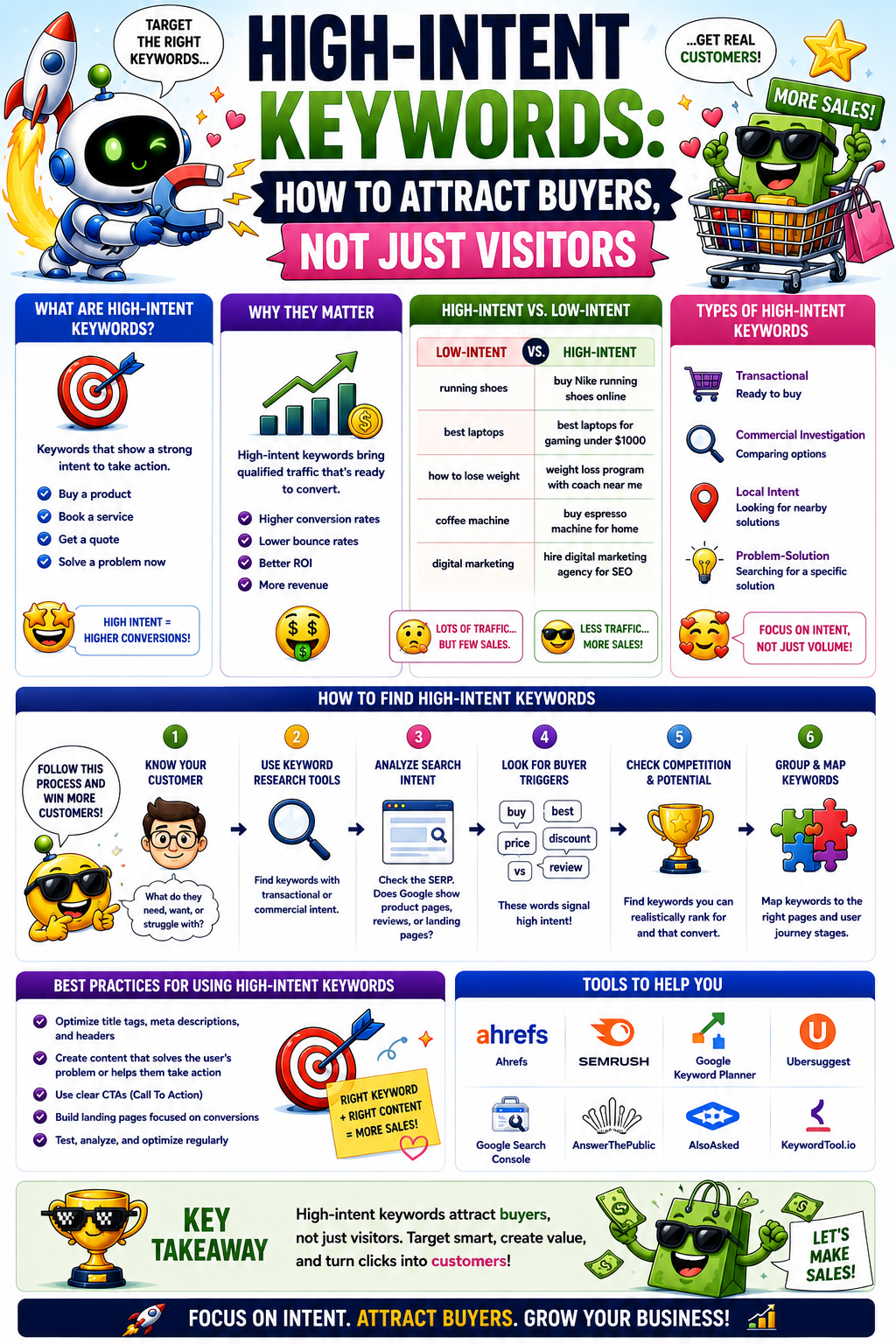
What Are High-Intent Keywords and Why Are They Critical for the US Market?
High-intent keywords are search queries that indicate a strong, immediate readiness by the user to make a purchase or complete a specific commercial action. In the hyper-competitive US market, targeting these terms is vital for capturing highly qualified prospects, minimizing wasted marketing spend, and driving a superior return on investment (ROI).
In the United States digital ecosystem, where the average cost-per-click (CPC) in Google Ads can easily surpass tens or even hundreds of dollars in premium niches, chasing generic informational traffic is an expensive misstep. American consumers and B2B decision-makers are highly transaction-oriented and typically perform search queries with an explicit end-goal in mind when they are ready to buy. By focusing on transactional and commercial investigation terms, businesses bypass the long, unpredictable lead-nurturing cycles of upper-funnel marketing. This strategy allows brands to directly target users at the bottom of the funnel (BOFU), where conversion rates are exponentially higher. Ultimately, mastering high-intent keyword optimization is the primary defensive and offensive strategy for surviving and scaling within the saturated search landscape of the US.
What is the Value Difference Between Informational and Transactional Search Queries?
Informational queries aim to acquire general knowledge or solve a conceptual problem (e.g., “how does CRM work”), whereas transactional queries indicate a direct intent to purchase (e.g., “buy Salesforce subscription online”). For US businesses, transactional queries hold significantly higher immediate economic value because they connect the brand with a user who is ready to purchase immediately.
- Informational Queries (TOFU): These terms attract massive search volume but yield very low direct conversion rates. Users search for free resources, checklists, or broad industry guides, requiring extensive nurturing before they ever contemplate a purchase.
- Transactional Queries (BOFU): While these queries have much lower search volume, they boast exceptionally high conversion rates. The searcher is already educated on the product or service and is actively comparing prices, terms, or packages to finalize their transaction.
The table below contrasts the distinct metrics and characteristics of these query types in the US market:
| Metric / Attribute | Informational Queries (TOFU) | Transactional Queries (BOFU) |
| Example Search Query | What is CRM software | Best Salesforce pricing discount |
| Funnel Stage | Top of the Funnel (TOFU) | Bottom of the Funnel (BOFU) |
| Search Volume | Very High | Low to Moderate |
| Conversion Rate (CVR) | Typically < 1% | 5% – 15%+ |
| Average CPC (US Ads) | Low | High to Extremely High |
Prioritizing transactional traffic ensures that marketing budgets are directed toward users who have already self-selected as ready buyers, rather than casual browsers seeking free information.
How Do You Identify High-Intent Keywords for the US Market?
Identifying high-intent keywords requires analyzing search query modifiers (such as buy, pricing, discount, vs, and best), evaluating advertiser competition levels, and analyzing historical Cost-Per-Click (CPC) data. A elevated CPC in Google Ads within the US market is the strongest algorithmic indicator that a keyword consistently generates high-value sales for advertisers.
Analyzing commercial intent on Google US requires looking beyond basic keyword metrics like search volume to understand the psychology behind specific search modifiers. Transactional modifiers like for sale, coupon, pricing, hire, or near me indicate that the user has their wallet out and is searching for the right portal to execute a transaction. Commercial investigation modifiers such as best, top, comparison, vs, or alternatives point to a user who is choosing between specific brands and is only one step away from buying. By systematically categorizing these modifiers and analyzing search patterns, search engine marketers can isolate the exact search queries that align with their business’s immediate revenue goals.
What Are the Best Keyword Research Tools for Finding High-Intent Search Terms?
The most effective tools for discovering high-intent search terms on the US market are Semrush, Ahrefs, and Google Keyword Planner. These platforms provide deep competitive intelligence, allowing marketers to filter search queries by intent classification, cost-per-click, and advertiser competition.
- Semrush: Offers a native “Intent” filter (Transactional, Commercial, Informational, Navigational) that allows SEOs to instantly isolate bottom-of-funnel keywords from massive databases.
- Ahrefs: Excel at reverse-engineering competitor landing pages, identifying which high-intent keywords drive the most commercial traffic to their highest-converting pages.
- Google Keyword Planner: Provides raw, direct-from-source bidding data, showing exactly what advertisers in the US are willing to pay for a click on specific transactional terms.
Using these tools in tandem allows you to bypass broad-match informational clutter, enabling your team to focus exclusively on high-yielding, transactional keyword opportunities.
How Does SERP Analysis Reveal the True Commercial Intent of a Search Query?
Analyzing the Search Engine Results Page (SERP) reveals true commercial intent by showing the exact types of content Google’s algorithm prioritizes for that query. The prominent display of Google Shopping ads, Google Ads blocks, Local Packs, or reviews confirms that Google classifies the query as highly transactional.
If the search results page for a target keyword is dominated by paid ads, product carousels, and local maps rather than long-form blog posts, Google has determined that the user is looking to buy immediately. Additionally, the presence of Google’s People Also Ask (PAA) blocks containing questions about pricing, return policies, or shipping costs further highlights the commercial nature of the search. Attempting to target these highly commercial SERPs with a generic informational article will rarely succeed because it fails to align with the transactional intent that Google’s algorithm demands. To win these rankings, you must align your content format directly with what the SERP is already successfully surfacing for active buyers.
How Do You Optimize Landing Pages for High-Intent Keywords?
Optimizing landing pages for high-intent keywords involves creating a friction-free user experience, highlighting clear Unique Value Propositions (UVPs), and placing prominent Calls to Action (CTAs). The page must instantly answer core purchasing questions regarding price, features, and benefits while establishing immediate credibility through social proof.
For the US market, where consumer skepticism is high and attention spans are low, a landing page must be meticulously designed to convert high-intent traffic instantly. Integrating your primary commercial keywords into key on-page elements – such as the H1 header, subheadings, and call-to-action anchors – validates to the visitor that they have landed on the correct page. Speed and accessibility are also critical ranking and conversion factors, as even a one-second delay in page load time can lead to a drastic drop in conversion rates among fast-paced American users. Implementing structured data markup (such as Product Schema, Offers, and AggregateRating) ensures your search listings display rich snippets, making your organic search results stand out in the SERPs.
Which On-Page SEO Techniques Yield the Highest Conversion Rates?
The on-page SEO techniques that yield the highest conversion rates include optimizing metadata with commercial CTR triggers, utilizing rich snippets, and implementing sticky CTAs. These technical adjustments capture searcher attention on the SERPs and guide users toward conversion actions once they arrive on the site.
- Meta Tag Optimization: Injecting high-conversion words (e.g., Free US Shipping, In Stock, Direct Pricing) into your title tags and meta descriptions can significantly boost click-through rates.
- Schema Markup Implementation: Using Product Schema to display pricing, rating stars, and product availability directly on the search results page increases pre-click trust.
- Logical Call-to-Action (CTA) Placement: Ensuring that clear CTA buttons (such as “Get Started” or “Add to Cart”) are placed above the fold and remain easily accessible throughout the user journey.
By executing these targeted on-page adjustments, you optimize not just for search engine visibility, but for maximum conversion potential.
How Do High-Intent Keywords Integrate Into a B2B SaaS Sales Funnel?
In the US B2B SaaS sector, high-intent keywords are mapped directly to the consideration and decision stages of the sales funnel to capture buyers ready to evaluate or purchase software. This is achieved by creating highly optimized comparison pages, pricing landing pages, and competitor alternative hubs.
Corporate decision-makers in the United States conduct exhaustive, independent research before ever booking a product demo or speaking with a sales representative. They rely heavily on specific search queries that target software categories, system integrations, and business use-cases – for instance, enterprise automated billing software reviews. Crafting targeted content that answers these high-intent queries ensures that your SaaS brand is visible during the critical moments of the buyer’s evaluation phase. Aligning your content strategy with these bottom-of-the-funnel queries reduces your overall Cost Per Lead (CPL) and shortens the sales cycle by attracting prospects who already understand their pain points and are actively looking for a solution.
Why Are Comparative and “Alternative” Search Queries Critical for US B2B Buyers?
Comparative queries (like HubSpot vs Salesforce) and search terms looking for brand alternatives (such as Mailchimp alternatives) are highly critical because they are used by prospects who are at the absolute peak of their purchasing decision. These searchers are actively comparing market solutions or are dissatisfied with their current provider and are ready to switch.
When a B2B buyer searches for comparisons or alternatives, they have already bypassed the broad educational phase of their journey and are evaluating their final options. By creating dedicated, highly objective comparison pages, you can actively control the narrative around your product’s unique advantages over your competitors. These pages should clearly highlight feature-by-feature comparisons, pricing transparency, and direct customer migrations to make the transition look as simple as possible. Winning the organic search rankings for your competitors’ branded “alternative” terms allows you to capture high-value market share directly from their customer base at a fraction of the cost of traditional acquisition channels.