


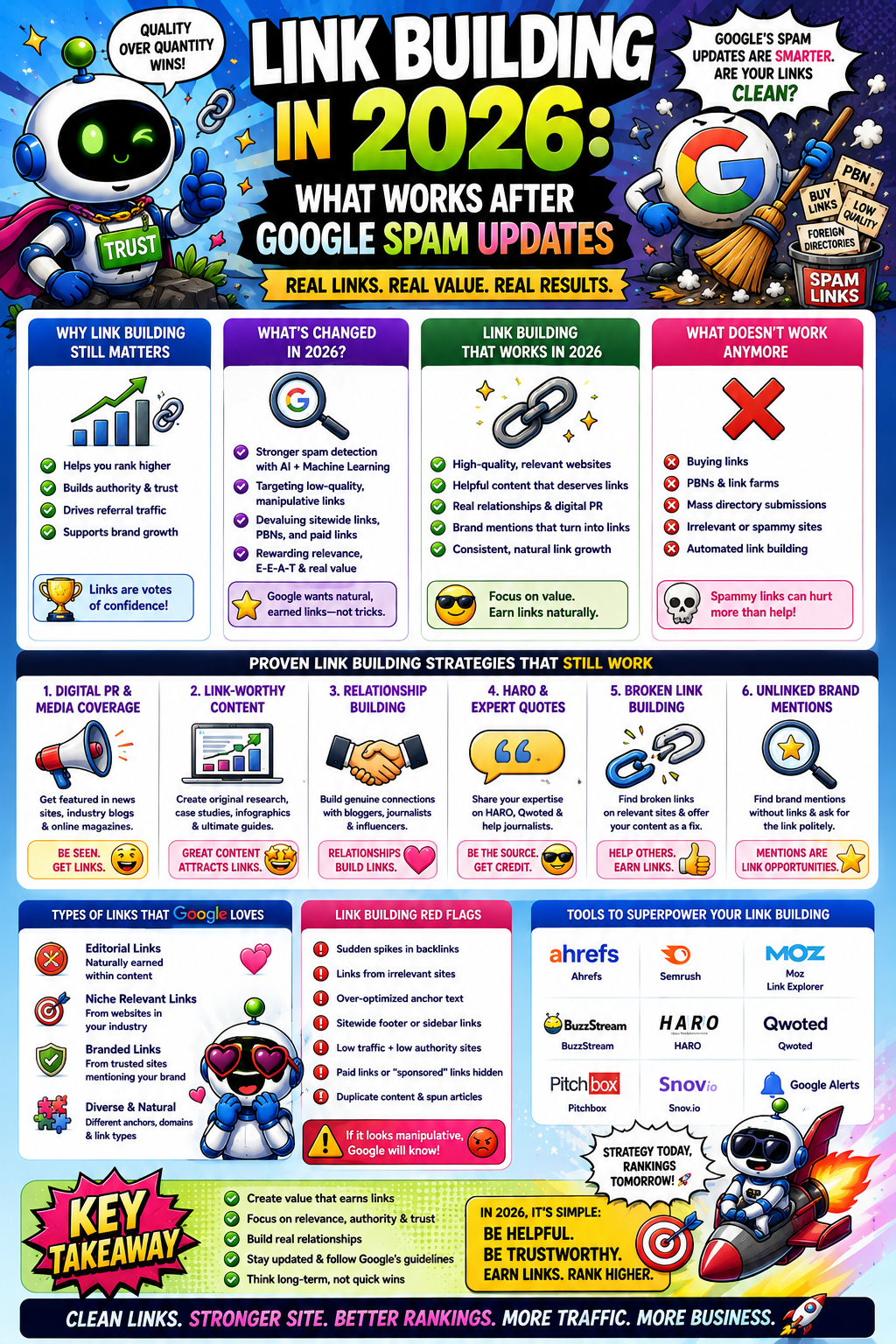
What Has Google’s Approach to Links Actually Changed Since 2022?
Google’s relationship with links has shifted from treating them as a primary vote of confidence to treating them as one signal among many — and a signal it actively discounts when it suspects manipulation. Since the 2022 link spam update, followed by the 2023 and 2024 helpful content and core updates, and the 2025 spam policy revisions, Google has made three things unambiguously clear: it can identify artificially placed links at scale, it penalizes patterns rather than individual links, and it has reduced the overall weight of links in its ranking systems for many query types. Understanding what changed — specifically — is the prerequisite for building a link strategy that survives the next update rather than just the last one.
The core shift is from link quantity to link signal quality. Prior to 2022, a domain with a large number of links from a diverse set of domains could outrank a domain with fewer but more authoritative, contextually relevant links in many competitive query categories. That equation has largely inverted. The algorithm now applies significantly more skepticism to links that appear in predictable, templated patterns — the same anchor text appearing across multiple domains, links appearing in author bio sections of guest posts at scale, links from domains whose only apparent purpose is linking out rather than serving a genuine audience.
What has not changed is the fundamental principle: a link from a genuinely authoritative, topically relevant source that editorially chose to reference your content because it deserves to be referenced is still one of the strongest signals in the algorithm. The question in 2026 is not whether links matter — they do — but whether the links you are earning are the kind Google’s systems are designed to reward or the kind they are increasingly designed to ignore or penalize.
What Types of Links Does Google’s Algorithm Still Reward in 2026?
In 2026, Google continues to reward links that share three characteristics simultaneously: editorial independence, topical relevance, and domain authority earned through genuine publishing history rather than domain age alone.
Editorial independence means the linking decision was made by a human editor, journalist, or content creator who had no financial or reciprocal relationship with the linked domain. The link exists because the editor judged the linked content to be genuinely useful for their readers — not because a payment was made, an exchange was agreed to, or a relationship obligated the placement. Google’s spam systems have become substantially more capable of detecting the absence of editorial independence: links from sites whose traffic is primarily SEO-bots rather than human readers, links from domains that publish content at a frequency inconsistent with a human editorial operation, and links appearing in content that serves no obvious purpose other than to contain the link.
Topical relevance has grown in importance relative to raw domain authority. A link from a domain with a moderate authority score but deep, consistent topical coverage of the subject matter linking to you carries stronger relevance signals than a link from a high-authority domain whose content covers an entirely different subject area. A cybersecurity company earning a link from a respected publication dedicated to enterprise IT security gets a different signal than the same company earning a link from a lifestyle magazine that happens to have high domain authority.
Authentic publishing history distinguishes domains that have built authority through years of consistently producing content that real audiences read and engage with from domains that have acquired authority artificially — through private blog networks, expired domain manipulation, or bulk link acquisition from low-quality sources. Google’s systems in 2026 evaluate not just the current state of a linking domain but its trajectory: a domain that had high authority, then changed hands, shifted topic focus, and now publishes at high volume with low engagement is a red flag rather than a valuable link source.
Which Link Building Tactics Are Effectively Dead in 2026?
Several tactics that produced measurable results as recently as 2022 are effectively dead in 2026 — not because Google has issued a specific policy update against each one, but because the systems detecting and discounting them have reached a level of sophistication that makes the risk-to-reward ratio negative.
Guest posting at scale for links — not guest posting as a genuine thought leadership exercise, but the practice of placing articles on third-party sites primarily to secure a followed link in the author bio or body — has been devalued to the point of irrelevance for most implementations. Google’s 2025 spam policy update specifically addressed “large-scale content production partnerships” and “byline manipulation,” and its systems have become capable of identifying the guest post pattern even when the article itself is high-quality. The signal that triggers devaluation is not low content quality alone — it is the pattern of a domain accepting guest contributions at scale from diverse authors whose only apparent connection to the publication is the link they receive.
Private Blog Networks (PBNs) — networks of sites built or acquired specifically to link to a target domain — have faced increasingly aggressive devaluation since 2022 and are effectively a liability in 2026. The detection methodology has matured: Google evaluates hosting patterns, IP ranges, registration histories, content freshness relative to traffic data, and cross-site anchor text patterns simultaneously. A PBN that was invisible to detection in 2020 is almost certainly visible today.
Link exchanges and reciprocal linking schemes — including the three-way exchange pattern designed to obscure the reciprocal nature of the arrangement — are identified and discounted by pattern analysis that looks at the link graph across thousands of domains, not just the two domains involved in an individual exchange.
Exact-match anchor text manipulation — building a pattern of followed links using the exact commercial keyword as anchor text — has been a reliable penalty trigger since the Penguin updates and remains so. In 2026, the threshold for triggering negative signals from over-optimized anchor text distribution is lower than it has ever been.
Directory and citation links from sites with no real audience — while legitimate directory citations for local businesses remain valuable for local SEO, general directory links from sites that exist primarily to host outbound links rather than to serve a genuine user need carry no positive signal and contribute to a link profile that looks artificially constructed.
What Link Building Strategies Are Producing Real Results in 2026?
The link building strategies that consistently produce measurable authority growth in 2026 are unified by a single characteristic: they start from genuine content value rather than from the link as the primary objective.
Does Digital PR Still Work for Link Building After the Spam Updates?
Digital PR — the practice of creating genuinely newsworthy content and earning editorial links through media coverage — remains the most scalable and defensible link acquisition strategy in 2026. It works precisely because it produces the type of link Google’s algorithm is designed to reward: an editorial decision by a genuine publication to reference a source because that source contains information worth citing.
The execution has evolved since 2022. Original data and research studies remain the most reliable format for earning high-authority links, but the bar for “genuinely interesting data” has risen as more brands have adopted data-driven PR as a strategy. A survey that produces predictable findings now earns less coverage than a survey with the same sample size that produces counterintuitive findings — because journalists cover surprises, not confirmations. The competitive advantage in digital PR in 2026 belongs to brands that can identify genuinely interesting questions within their domain, collect or analyze data that answers those questions in unexpected ways, and present that data in a format that makes a journalist’s job easier rather than harder.
Reactive PR — positioning executives or subject-matter experts as responsive sources for journalists covering breaking news — has become more valuable as news cycles have accelerated. A company whose expert can provide a specific, technically precise comment on a relevant news event within four hours of the story breaking earns more editorial links and mentions than one that responds three days later with a polished but generic statement. Speed and specificity are the competitive advantages in reactive PR, and they are more accessible to smaller brands than the large-scale research campaigns that require significant production budgets.
Does Resource Link Building Still Work in 2026?
Resource link building — creating genuinely useful tools, guides, datasets, or reference materials that other sites link to because their users benefit from the resource — remains effective in 2026 because it aligns with what Google’s systems are designed to reward. The distinction between resource link building that works and resource link building that has been devalued is whether the resource was created to be genuinely useful or created primarily to attract links with the resource’s usefulness as a pretext.
A free tool that solves a real problem in an industry — a calculation tool, a template library, a data reference — earns editorial links because people who find it genuinely useful share it with audiences who would also benefit from it. A “resource page” that is a thinly veiled landing page for a product, dressed up with some statistics and a few outbound links to demonstrate apparent generosity, earns links only through outreach — which means every link it earns is an outreach-solicited link rather than an editorially earned one, a distinction that is increasingly legible to Google’s systems.
Is Broken Link Building Worth the Effort in 2026?
Broken link building — identifying dead links on authoritative pages and offering your content as a replacement — remains technically valid but has become significantly more effort-intensive relative to its yield. The inventory of broken link opportunities on genuinely authoritative pages has not grown proportionally to the number of practitioners running broken link campaigns, which means the best opportunities are identified quickly and the outreach conversion rate for broken link building has declined relative to earlier years.
It is worth including as a component of a broader link acquisition strategy — particularly for finding natural link replacement opportunities in genuinely authoritative content — but it is not a scalable primary strategy for most sites.
How Does Original Research Drive Link Acquisition at Scale?
Original research — proprietary surveys, data analysis, industry benchmarks, or original datasets — is the closest thing to a link acquisition strategy that scales reliably, compounds over time, and produces the types of links that most directly benefit domain authority. It works because it creates a citable asset: something that journalists, bloggers, researchers, and content creators in a given field need to reference when writing about the topics the research addresses.
The compounding effect is particularly valuable. A well-executed research study or annual industry report earns links not just on initial publication but on every subsequent mention, citation, or coverage piece that references the data months or years after publication. The first year of publishing an annual industry benchmark study may earn 15 to 30 referring domains. By the third year, the accumulated citation authority of the recurring study has made it a standard reference in its category — earning links on autopilot each time the category is written about.
The execution requirements have risen in 2026. Research that relies entirely on publicly available secondary data, repackaged without meaningful original analysis, earns less coverage than it would have three years ago. The most effective original research studies either collect primary data through surveys or proprietary data access, apply meaningful analytical rigor to secondary data to produce genuinely new insights, or combine both approaches to produce findings that could not have been produced without the brand’s specific access or expertise.
How Has the Role of Anchor Text Changed After Google’s Updates?
Anchor text strategy in 2026 is less about optimization and more about naturalization — specifically, ensuring that the anchor text distribution across a site’s inbound link profile looks like what a site would naturally accumulate if it were earning links through genuine editorial coverage rather than through deliberate link acquisition.
A naturally accumulated anchor text profile in most industries consists predominantly of branded anchors (the company name, the domain, or a variation thereof), a significant proportion of generic anchors (“click here,” “this article,” “read more”), a moderate proportion of naked URL anchors (the URL itself used as the anchor), and a relatively small proportion of keyword-anchored links — the exact proportion varying by industry and content type. Over-representation of exact-match commercial keyword anchors is the most reliable signal of an artificially constructed link profile, and it remains a meaningful trigger for algorithmic devaluation or manual review in 2026.
The practical implication is that intentional anchor text optimization during link acquisition outreach is counterproductive. Outreach that requests a specific anchor text produces a pattern that is inconsistent with editorial link behavior. Outreach that provides relevant content and leaves the anchor text decision to the editorial discretion of the linking site produces a more natural distribution — and is also more likely to succeed as an outreach pitch, because it is not asking the journalist or editor to do something they would not naturally do.
What Does a Safe and Effective Link Velocity Look Like in 2026?
Link velocity — the rate at which a domain acquires new referring domains over time — is evaluated by Google’s systems in the context of what is expected for a site of that type, age, and category. A brand new domain acquiring 50 new referring domains in its first month of existence is a strong spam signal. An established domain that has historically acquired 3 to 5 new referring domains per month and then suddenly acquires 200 in a single month without a corresponding news event is also flagged.
Natural link velocity reflects a site’s real-world activity. A site that publishes substantial, shareable content consistently, earns press coverage, and engages in genuine community activity in its industry will naturally accumulate new referring domains at a rate that reflects its publishing frequency and media engagement. The safest and most sustainable link velocity is one that mirrors this natural pattern — not one that is calibrated to a specific number per month as an SEO target.
The most common velocity-related mistake in 2026 is campaign-based link acquisition that produces a visible spike followed by near-inactivity. A link acquisition program that earns 40 new referring domains in a six-week campaign and then earns almost nothing for the following four months creates a spike pattern in the link velocity chart that is inconsistent with organic editorial behavior. Distributing acquisition activity across a longer period, even at a lower monthly rate, produces a more sustainable signal.
How Do You Evaluate Link Quality in 2026?
Evaluating link quality in 2026 requires looking beyond domain authority scores produced by third-party tools — which are lagging indicators of link profile quality — to the underlying characteristics that make a link valuable or harmful.
Traffic from real human visitors is an increasingly important quality signal. A domain with a high authority score but minimal human traffic — discoverable through tools that estimate organic and referral traffic — is likely a domain that acquired its authority through manipulation rather than genuine publishing. Links from domains with no real human audience do not pass meaningful signal regardless of their technical authority score.
Content freshness and publishing consistency relative to the domain’s apparent age and traffic is a quality signal that is easy to evaluate manually. A domain that was publishing frequently and earning engagement two years ago but has published nothing in the last six months is depreciating in value as a link source. A domain that publishes at high frequency but has consistent near-zero engagement metrics is publishing for crawlers rather than readers.
Topical alignment between the linking content and the linked content remains a meaningful quality factor. Evaluate not just whether the linking domain is generally relevant to the linked site’s category, but whether the specific page containing the link is topically aligned with the specific page receiving the link.
Link placement within the page — specifically whether the link appears within the editorial body content of a page, in a sidebar, in a footer, or in an author bio — affects the signal weight the link carries. In-content editorial links carry stronger signal than navigational, sidebar, or footer links, all of which carry weaker or near-zero signal depending on the implementation.
What Is the Relationship Between E-E-A-T and Link Building in 2026?
E-E-A-T — Experience, Expertise, Authoritativeness, and Trustworthiness — and link building are not separate disciplines in 2026; they are two expressions of the same underlying quality signal. High-authority editorial links are one of the primary mechanisms through which a site’s Authoritativeness signal is built and recognized by Google’s systems. A site that is genuinely authoritative in its field will naturally attract links from other authoritative sources in that field — which is both the cause and the evidence of its authority.
This relationship has practical implications for how link building is resourced and executed. A link building program that operates independently of a brand’s content quality, E-E-A-T signals, and genuine industry authority will consistently underperform relative to a program integrated with the brand’s content strategy and expert positioning. The highest-leverage link building activity in 2026 is often not outreach — it is creating content, expertise, and industry positioning so genuinely valuable that links follow as a byproduct.
Conversely, a site with strong E-E-A-T signals that has not actively pursued link building will often naturally accumulate more and higher-quality links than a site with weaker E-E-A-T signals running an active link acquisition program. The practical lesson is that investing in the quality signals that make a site worth linking to produces better long-term link acquisition results than investing the same resources in outreach to acquire links to a site that doesn’t yet deserve them.
How Should You Audit Your Existing Link Profile for Spam Risk in 2026?
A link profile audit in 2026 should evaluate the profile against the patterns that Google’s spam systems are most likely to flag, rather than simply identifying low domain authority links for disavowal.
The first priority is identifying patterns rather than individual links. A single low-quality link from a directory site is not a meaningful spam risk. A pattern of 200 links from directory sites with similar IP ranges, similar content templates, and no human traffic is a different situation entirely. Pattern identification requires looking at the link profile at scale — sorting by linking domain characteristics, anchor text distribution, link placement type, and geographic concentration to identify clusters that suggest artificial construction.
The second priority is identifying links from domains that have been algorithmically devalued or are likely to be devalued in future updates. These include domains that were high-authority but have been abandoned, repurposed as link farms, or acquired by new owners who changed their content focus; domains whose traffic has dropped significantly since a major Google update without a corresponding recovery; and domains that now primarily publish AI-generated content at high volume with no evidence of editorial oversight.
The disavowal tool remains available and appropriate for links that could be causing active harm — links from sites that have received manual actions, links from domains associated with prior spam schemes, or patterns of links that match the profile of link schemes Google has publicly addressed. The disavowal threshold in 2026 is narrower than in earlier years because Google’s algorithmic devaluation has become more comprehensive — many links that would have required disavowal in 2018 are now simply ignored algorithmically. Disavowing ignored links does not help and creates a record of the link’s existence in your disavowal file without benefit.
What Does a Sustainable Link Building Program Look Like in 2026?
A sustainable link building program in 2026 is built around three operational commitments that distinguish it from campaign-based or tactic-based approaches: consistent content production that creates linkable assets, systematic media and relationship development that creates editorial link opportunities, and ongoing monitoring that catches link profile deterioration before it compounds.
Consistent content production means treating linkable asset creation — original research, data studies, interactive tools, comprehensive reference guides — as a recurring investment rather than a one-time campaign. A brand that publishes one major original research study per quarter has four opportunities per year to generate editorial coverage and links, and the compounding effect of four annual studies over three years creates an institutional citation authority that a single-campaign approach cannot produce.
Systematic media and relationship development means building relationships with journalists and editors in the brand’s category as an ongoing activity, not as a precursor to a specific pitch. Journalists who know a brand as a responsive, credible, expert source are more likely to reach out for commentary, more likely to cover original research when it is published, and more likely to include followed links when they do. These relationships take time to develop and cannot be manufactured on demand.
Ongoing monitoring means tracking not just the acquisition of new links but the health of the existing link profile — monitoring for link loss from previously valuable referring domains, watching for new links from suspicious sources that the brand did not earn through any deliberate activity, and evaluating link quality shifts as domains that were previously high-quality change ownership or publishing focus.
The programs that produce the most durable domain authority growth in 2026 are not the ones with the highest link acquisition volume — they are the ones that most consistently earn the kind of links that Google’s systems are designed to reward, at a velocity that is consistent with genuine editorial behavior, in a profile that reflects the brand’s genuine authority and expertise in its field.
Conclusion
Link building in 2026 is not dead — it is clarified. The updates since 2022 have not made links less important; they have made the difference between links that matter and links that don’t matter more legible. The tactics that produce meaningful results are the ones that have always been theoretically correct: earn links by being genuinely worth linking to, create content that other publishers want to reference, build the kind of authority and expertise that makes editorial links a natural byproduct of a brand’s presence in its field.
The practical shift required is not a tactical pivot from one link building method to another — it is an orientation shift from “how do we acquire links” to “how do we become the kind of site that earns links.” That shift is harder to execute than switching tactics, but it is also more durable, more defensible against future updates, and more aligned with the direction Google’s systems have been consistently moving for the past four years.