


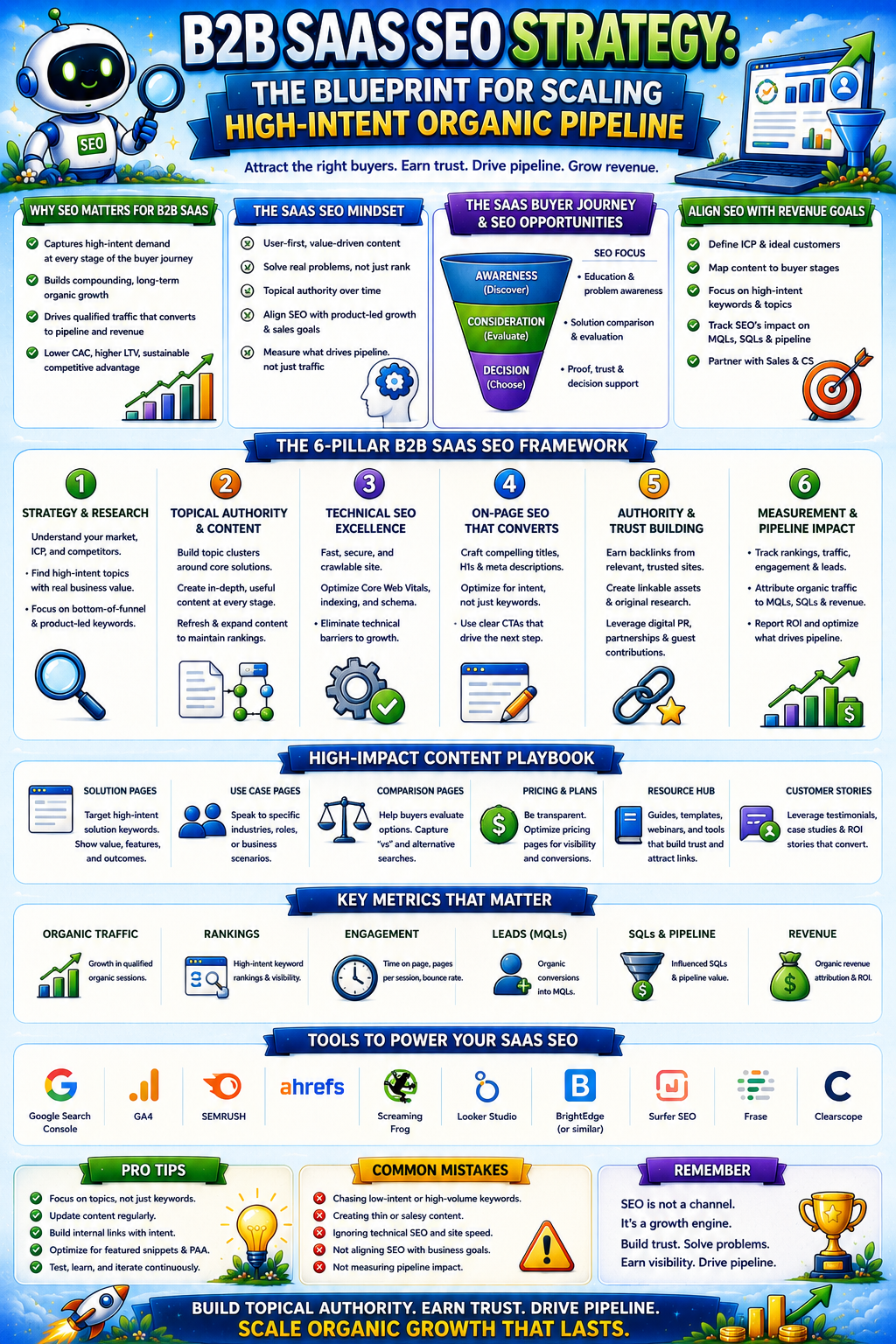
The Silicon Valley playbook for scaling B2B SaaS has experienced a systematic structural failure. The historical default-injecting millions of dollars into Google Ads, LinkedIn Paid Social, and programmatic retargeting to drive demo signups-has broken under the weight of surging Customer Acquisition Costs (CAC), privacy-first data tracking limitations, and deteriorating ad network efficiency.
When venture capital access tightens and paid acquisition efficiency chokes, the boardroom immediately turns its eyes to organic search. Yet, the standard playbook delivered by legacy organic marketing agencies is equally broken.
Most tech platforms are trapped in an organic traffic illusion. Their blogs generate hundreds of thousands of organic visits every month, while their Annual Recurring Revenue (ARR) growth remains completely stagnant. They rank for high-volume informational keywords that attract students, career changers, and low-tier freelancers, while their actual target economic buyers-VPs of Finance, Chief Information Security Officers (CISOs), or Directors of Engineering-never see their brand.
To build a predictable, repeatable customer acquisition engine for the highly competitive US market, you must abandon traditional keyword-driven content marketing. You must pivot to an infrastructure-backed, product-led SEO framework engineered specifically to generate high-intent pipeline, convert trial users, and accelerate your monthly organic ARR.
1. The Death of Search Volume: Why Your SaaS Content Strategy is Failing
The single greatest mistake in SaaS content production is an over-reliance on third-party SEO tool metrics. Tools like Ahrefs or SEMrush provide macro-estimates of monthly search volume (MSV) and keyword difficulty (KD). This data, when used blindly by marketing departments, leads to an execution trap: chasing high-volume keywords to satisfy vanity metrics on a CMO dashboard.
Consider the reality of a B2B FinTech SaaS platform. A marketing manager sees that the query “what is corporate spend management” has a search volume of 12,000 requests per month. They spend $1,500 on an agency article, optimize it perfectly, acquire high-tier backlinks, and achieve position #1 in Google US. The traffic graph shoots up. The team celebrates.
But what is the true conversion rate of that traffic?
[Traditional Content Marketing Trap]
High Search Volume Query (“What is a KPI?”) ➔ Massive Traffic ➔ 0.01% Conversion ➔ High Churn / Low Lifetime Value
[Product-Led SEO Framework]
Low Volume/High-Intent Query (“Automate Multi-Currency Invoice Reconciliation”) ➔ Low Traffic ➔ 12.5% Conversion ➔ High ARR / Enterprise Retention
The user searching for “what is corporate spend management” is looking for an academic definition. They are likely a junior accountant writing a report, a college student, or a competitor doing research. They do not have the budget, the intent, or the authority to purchase software.
Contrast this with a query like “multi-currency accounting software for multi-entity international corps”. This query might show zero search volume in Ahrefs. Yet, the person typing this specific phrase into Google is currently experiencing severe operational pain. They are an economic buyer with a credit card in hand or an enterprise budget allocation ready.
The Traffic vs. Pipeline Formula
To fix your SaaS SEO metrics, you must replace the concept of Traffic Volume with Pipeline Velocity. The actual ROI of a SaaS organic content piece can be expressed through a simple mathematical relationship:
$$ROI_{Content} = \frac{(Organic\ Traffic \times Conversion\ Rate\ to\ MQL \times MQL\ to\ SQL\ Win\ Rate \times ACV) – Cost\ of\ Content\ Production}{Cost\ of\ Content\ Production}$$
Where ACV is your Annual Contract Value. If your organic traffic is 100,000 but your conversion rate to a Marketing Qualified Lead (MQL) is $0.001\%$, your pipeline is zero. If your traffic is 500, but your conversion rate to a Sales Qualified Lead (SQL) is $10\%$ with a $20\%$ close rate on a $\$50,000$ ACV product, that single page generates $\$50,000$ in ARR.
2. Mapping Keywords to the SaaS Product Funnel (BOFU over TOFU)
To scale ARR efficiently, your content deployment strategy must be built from the bottom of the funnel up. Traditional marketers start with Top-of-the-Funnel (TOFU) awareness content because it is easy to write and ranks quickly. Elite tech brands do the exact opposite: they exhaust Bottom-of-the-Funnel (BOFU) transactional keywords first to secure revenue, then expand upwards.
/\ TOFU: Informational (“What is billing software?”) – Low Conversion
/ \
/—-\ MIDDLE: Evaluation (“Best subscription billing platforms”)
/ \
/——–\ BOFU: High-Intent (“Stripe Alternatives”, “Chargebee vs Recurly”) – Max ROI
Strategy A: The “X Alternatives” Playbook
When a buyer searches for [Industry Giant] alternatives, they are actively dissatisfied with their current provider. They are in the final stage of evaluation. They want out of their current contract, or they have outgrown the incumbent’s feature set.
Look at how ClickUp systematically scaled its early-stage pipeline. They didn’t start by trying to rank for “project management software”. Instead, they built dedicated landing pages targeting:
- Asana Alternatives
- Trello Alternatives
- Monday.com Alternatives
These pages must not be cheap corporate hit-pieces. To rank and convert in the US market, they must provide objective, highly technical feature-by-feature comparisons. If your software lacks an enterprise feature that the competitor has, state it honestly. This builds trust and filters out bad-fit clients who would otherwise inflate your customer success churn metrics.
Strategy B: The “Competitor vs. Competitor” Hub
Buyers frequently narrow down their software selection to two major players. They search for [Competitor A] vs [Competitor B].
As a nimble or emerging SaaS player, you have a massive strategic opportunity: build the definitive comparison guide for them. By creating a neutral, highly analytical three-way comparison (Our SaaS vs Competitor A vs Competitor B), you position your platform as the modern alternative that fixed the legacy flaws of both incumbents.
Critical Architecture for Comparison Pages:
- Feature Comparison Matrix: A clean, scannable table contrasting API access, webhook speeds, data encryption standards, and pricing tiers.
- Migration Path: A prominent section showing how easy it is to import data from Competitor A and Competitor B into your platform with a single click.
- Social Proof: Specific testimonials from engineering or operations teams who recently made the exact switch you are advocating for.
Strategy C: Job-to-be-Done (JTBD) Queries
People do not buy software for its features; they hire software to do a specific job. This is the Job-to-be-Done framework applied to search intent.
Instead of targeting keywords that describe your category, target keywords that describe the pain point or execution state.
| Category-Driven Keyword (Avoid First) | JTBD / Pain-Driven Keyword (Target First) |
| Automated HR Platform | how to automate payroll compliance across state lines |
| Enterprise CRM Software | sync salesforce data to bigquery in real time |
| SaaS Analytics Tool | how to calculate user retention cohorts automatically |
By writing highly technical, step-by-step guides that solve the exact query using your software as the primary tool, you create an uninterrupted path from problem to product activation.
3. Programmatic SEO: Scaling to 10,000 Landing Pages Without Writing 10,000 Articles
For enterprise-level SaaS projects, manual content creation cannot scale fast enough to capture every long-tail keyword variation. If your product solves a problem that involves thousands of integrations, locations, file types, or industry variations, you must deploy Programmatic SEO (pSEO).
Programmatic SEO is the process of using database architecture to generate thousands of high-quality, search-intent-optimized landing pages dynamically.
The Master of pSEO: Zapier
Zapier’s organic acquisition engine is a work of structural art. They did not hire an army of copywriters to write 20,000 articles about integrations. Instead, they built a database that automatically generates three tiers of programmatic pages:
- App Landing Pages: /apps/hubspot
- App-to-App Integration Pages: /apps/hubspot/integrations/jira
- Specific Trigger/Action Pages: /apps/hubspot/integrations/jira/new-lead-create-issue
[Zapier Core App Page: /apps/hubspot]
|
—————————————————
| |
[/apps/hubspot/integrations/jira] [/apps/hubspot/integrations/slack]
|
[/apps/hubspot/integrations/jira/trigger-action-url]
This single database architecture captures millions of monthly search visits from users looking for hyper-specific solutions like “how to connect hubspot leads to jira tickets”.
Avoiding the 2026 Google “Thin Content” & HCU Filters
In 2026, Google’s helpful content systems and core quality algorithms are hyper-sensitive to low-value, automated pages. If you simply spin text across 5,000 pages using boilerplate templates, your entire site will face an algorithmic devaluation.
To run programmatic SEO successfully today, every generated page must contain unique, high-utility data assets:
- Dynamic Code Blocks: If your page targets a developer audience, show actual, working API payload examples or configuration scripts that dynamically update based on the page parameters.
- Unique UI Previews: Display dynamic screenshots or interactive mockups of how the integration or solution looks within your application dashboard.
- Dynamic Schema Markup: Embed unique SoftwareApplication and HowTo structured data arrays directly into the JSON-LD header of each programmatic variant.
Example JSON-LD Schema for Programmatic SaaS Page:
JSON
{
“@context”: “https://schema.org”,
“@type”: “SoftwareApplication”,
“name”: “SeoProsecco Pipeline Automator”,
“operatingSystem”: “All”,
“applicationCategory”: “BusinessApplication”,
“offers”: {
“@type”: “Offer”,
“price”: “49.00”,
“priceCurrency”: “USD”
},
“featureList”: “Real-time log syncing, multi-region database replication, automated reverse DNS verification”
}
4. The Tech Stack Audit: Handling JavaScript SEO on Headless SaaS Architectures
The vast majority of modern US tech SaaS platforms are built using modern JavaScript frameworks-primarily Next.js, React, Nuxt, or Vue. While these frameworks allow engineers to build lightning-fast, interactive web applications, they frequently destroy a site’s organic search visibility if configured incorrectly.
Googlebot has two distinct phases of processing web pages: The Initial Pass and The Render Pass.
[HTML Source Received] ➔ Phase 1: Immediate Indexing (Text/Links in raw HTML)
|
[Google Render Queue] (Requires heavy CPU)
|
Phase 2: JavaScript Execution (Days/Weeks Delay)
If your marketing pages rely entirely on client-side rendering (CSR), Googlebot’s first pass sees an empty HTML shell: <body><div id=”__next”></div></body>. The actual text, images, and internal navigation links only appear after Google executes the JavaScript.
Because the Render Pass requires massive computational power, Google places your JS pages into a queue. This queue can introduce an indexing delay of anywhere from 48 hours to three weeks. For fast-moving B2B platforms launching continuous feature updates or programmatic landing pages, this delay is unacceptable.
Engineering Requirements for SaaS SEO:
To eliminate the rendering gap, your marketing site must run on a decoupled architecture using either Static Site Generation (SSG) or Server-Side Rendering (SSR) with Incremental Static Regeneration (ISR).
- Server-Side Rendering (SSR): The server processes the JavaScript, builds the complete HTML document with all data fetched from your CMS, and serves a fully realized, static HTML payload to Googlebot on the very first hit.
- Hydration Checks: Ensure your engineering team tests for hydration errors. If there is a mismatch between the pre-rendered HTML from the server and the final DOM executed on the client side, Googlebot may fail to parse your primary navigation links, leaving deep product pages un-crawled.
Core Web Vitals at Enterprise Scale
Google’s Core Web Vitals-specifically Interaction to Next Paint (INP) and Largest Contentful Paint (LCP)-are direct algorithmic ranking signals.
SaaS marketing sites are notorious for being bloated with heavy marketing scripts: HubSpot tracking pixels, Hotjar heatmaps, Google Tag Manager containers, Intercom chat widgets, and custom animation libraries.
To preserve your technical health, enforce a strict script loading policy using next/script or a native tag management solution that defers non-critical execution until after First Input Delay (FID). Move your live chat initialization to a user-interaction trigger (e.g., do not load the Intercom script until the user hovers over the chat icon).
5. Digital PR and Enterprise Link Building for High Domain Authority (DR)
The classic link-building playbook-buying spammy guest posts on low-quality blogs or exchanging links in private Slack groups-does not work in the US enterprise market. Google’s automated spam detection systems easily neutralize artificial backlink profiles.
To move the needle for competitive terms like enterprise project management platform, you need high-authority, editorial contextual backlinks from legitimate digital publications (e.g., TechCrunch, Forbes, Business Insider, Harvard Business Review) and high-DR SaaS domains (e.g., HubSpot, G2, Salesforce).
The Proprietary Data Strategy (The Link Magnet)
The most elegant way to acquire hundreds of high-DR natural backlinks is to leverage your product’s internal data asset. Your software sits on top of aggregate user data that contains fascinating industry insights.
- Anonymize and Aggregate: Extract macro-trends from your database. (e.g., If you run a remote HR SaaS, extract data on The Average Time-to-Hire for Software Engineers in the US Across Q1).
- Design Data Visualizations: Build clean, high-contrast charts and data matrices that highlight these trends.
- Publish an Annual Benchmark Report: Create a comprehensive, un-gated report optimized for terms like remote hiring statistics 2026 or tech industry turnover benchmarks.
When journalists, academic researchers, and industry bloggers write their own content throughout the year, they actively search for statistical validation. They will find your data visualizations, cite your metrics, and link directly back to your resource hub as the original source. This creates a perpetual, natural backlink acquisition loop.
Building Product-Led Free Tools
Another highly successful acquisition framework involves building a hyper-focused, free mini-tool that resides on a subdomain or a specific subdirectory of your main marketing site.
- Examples: HubSpot’s Invoice Generator, Shopify’s Business Name Generator, or CoSchedule’s Headline Analyzer.
[Free Tool: /tools/invoice-generator]
|
——————————————————-
| | |
Natural Press Links Academic Backlinks High-Volume Referral Traffic
| | |
——————————————————-
|
Passes Link Equity (PageRank)
|
▼
[Core Product Page: /products/billing-saas]
These tools solve a simple, immediate micro-problem for your target demographic. Because they offer immediate utility without requiring an upfront financial commitment, they are highly shareable across community platforms like Reddit, Hacker News, and Product Hunt, passing massive PageRank equity down to your core transactional product paths.
6. Measuring Success: SaaS SEO Metrics That Actually Matter to the Board
If you present a chart showing an increase in “Organic Impressions” or “Keyword Rankings” to a B2B SaaS Board of Directors or a venture capital investment committee, you will lose internal credibility. Executive teams care about capital efficiency, user acquisition velocity, and financial growth. Your organic metrics must map directly to the company’s financial model.
The Corporate SEO Dashboard:
- Organic Pipeline Contribution: The total dollar value of opportunities inside your CRM (Salesforce/HubSpot) that originated from an organic search landing page.
- Organic ARR / MRR Attribution: The amount of recurring revenue directly generated by users who signed up for a trial or a demo via organic entry points.
- LTV to CAC Ratio by Channel: Compare the Lifetime Value (LTV) and Customer Acquisition Cost (CAC) of organic search users against paid performance advertising users. Historically, organic search users display significantly higher retention rates and longer customer lifespans.
+————————————+—————————————+
| Vanity SEO Metrics | Boardroom ROI Metrics |
| (Drop from Executive Reports) | (Focus of Enterprise Teams) |
+————————————+—————————————+
| * Total Organic Clicks | * New Monthly Organic MRR Added |
| * Top 10 Keyword Rankings | * Cost Per Acquisition (Organic CAC) |
| * Blog Impressions Trend | * Total SQLs Sourced From Search |
| * Total Traffic Volume | * Organic Customer Retention / LTV |
+————————————+—————————————+
To achieve precise reporting, you must deploy an attribution model that tracks the entire user journey. Many enterprise buyers read a product comparison page (Organic Touchpoint 1), leave, see a retargeting ad on LinkedIn (Paid Touchpoint 2), and finally type your brand name directly into Google to convert (Direct/Organic Touchpoint 3).
If you use a simplistic Last-Touch attribution model, your paid channels will steal all the credit, and your content budget will be prematurely cut. Deploy First-Touch or Linear Multi-Touch Attribution to prove exactly how your technical content assets initiated the pipeline pipeline.
Conclusion: The Long-Term Compounding Asset
Paid media is a transactional expense: the moment you stop paying the ad network, your lead generation drops to absolute zero. Organic search, when executed through a technical, product-led framework, behaves like a compounding financial asset.
An article written today, an API page generated next week, or a data report launched this quarter will continue to attract high-intent economic buyers, generate product signups, and scale your ARR month after month, year after year, for a fraction of the cost of traditional outbound playbooks.
Stop chasing empty search volume. Stop writing fluff articles for non-buyers. Build an infrastructure that aligns your product’s core utility with the exact search patterns of your highest-value customers.