


If your blog feels like a mess of unconnected articles, Google probably agrees. Many businesses publish great content week after week, only to watch it sink into page three of the search results. The problem isn’t the quality of your writing; it’s the lack of structure.
In the early days of SEO, you could rank by targeting a single keyword per article. Today, search engines look at the bigger picture. They want to see depth, context, and a clear relationship between your pages.
To build real organic authority, you need to shift from publishing random blog posts to creating organized content networks. This guide will show you exactly what topic clusters and pillar pages are, how they transform your SEO content strategy, and how to build a scalable framework that turns casual readers into customers.
What Are Topic Clusters and Pillar Pages?
The internet is crowded, and search engines have evolved to understand user intent rather than just matching exact words. To rank well today, your website needs a structured blueprint. That is where the hub and spoke model comes into play.
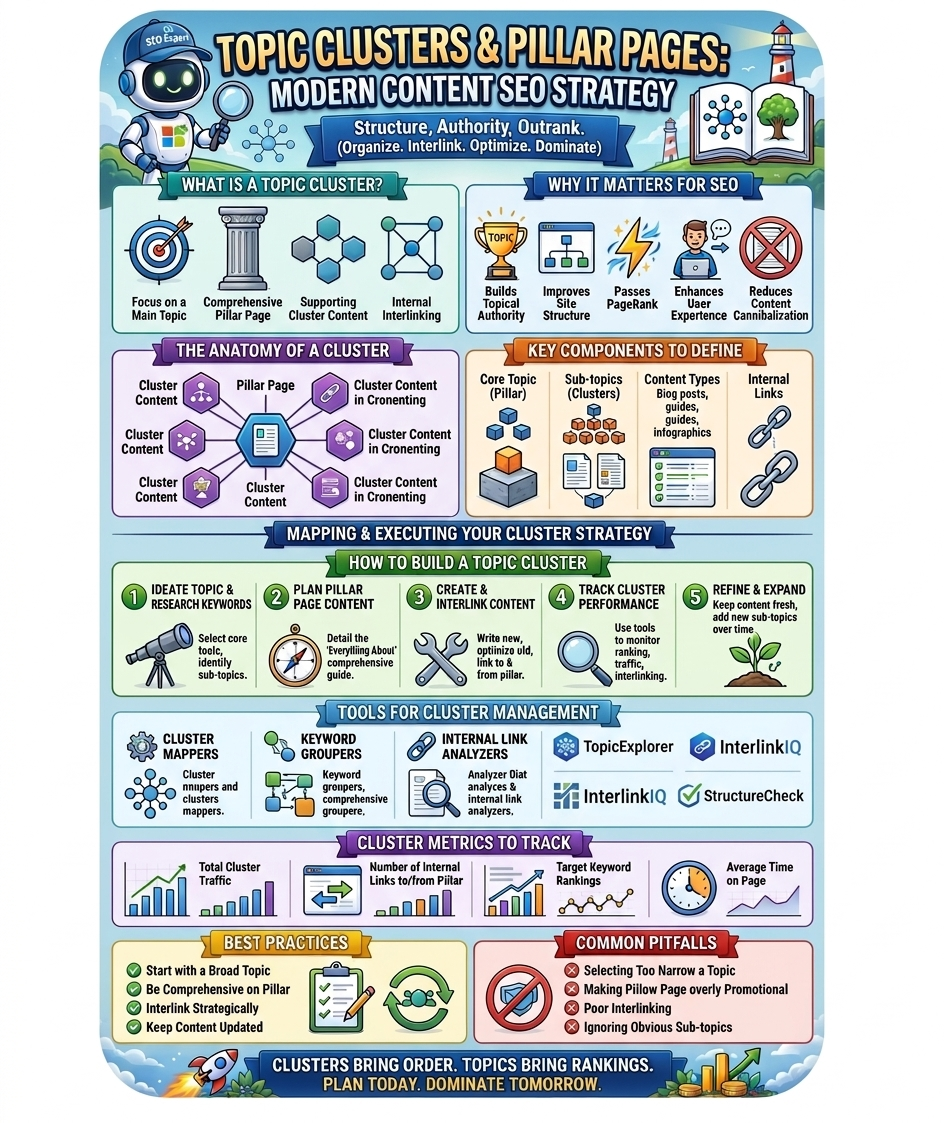
Defining the Structure
Think of this strategy as a highly organized digital filing system for your website. It consists of three core components:
-
The Pillar Page: A comprehensive, long-form guide that covers a broad core topic in detail. It provides a high-level overview of the subject but leaves room for deeper explanations in subtopics.
-
Cluster Content: Supporting blog posts or subpages that dive deep into specific, narrow angles of that core topic. Each cluster page targets distinct long-tail keywords.
-
Internal Linking: The hyperlinks that connect the pillar page to every cluster post, and vice versa. This creates a two-way street for search crawlers and users.
The Table Analogy: Imagine your pillar page is a tabletop. The cluster pages are the legs supporting it. Without the legs, the tabletop falls. Without the tabletop, the legs are just isolated pieces of wood. Internal linking is the glue that locks them together into a single, functional structure.
Why Google Loves This Structure
Google no longer just looks at individual keywords; it focuses on topical relevance and semantic search. Algorithms like BERT and MUM are designed to understand how words relate to each other and whether a website provides an exhaustive answer to a user’s problem.
When you group related articles into a clear content silo, you give search engines explicit context. You show them that your site isn’t just guessing at a topic—you own it. This clear SEO blog structure makes it incredibly easy for Googlebot to crawl your site, map your content paths, and index your pages accurately.
Benefits of Using Topic Clusters for SEO
Switching to a structured SEO structure completely changes how your site performs in organic search. Instead of hoping a single article ranks, you lift your entire domain’s visibility.
Implementing content clusters offers several distinct advantages:
-
Dominating Long-Tail Traffic: While your pillar page targets high-volume, competitive phrases, your cluster posts capture highly specific, high-intent search queries.
-
Building Rapid Topical Authority: When you publish multiple interconnected articles on a single subject, search engines recognize your site as an expert resource.
-
Maximizing Internal Linking Efficiency: Link equity flows smoothly throughout your entire site architecture. When one cluster post gains backlinks, it passes that authority back to the pillar and neighboring pages.
-
Eliminating Keyword Cannibalization: A clean keyword hierarchy ensures your own blog posts aren’t competing against each other for the exact same search terms.
-
Improving the User Experience (UX): Visitors can easily navigate from a general overview to highly technical subtopics, keeping them on your site longer and reducing bounce rates.
How to Build a Topic Cluster Strategy
Building a successful cluster requires careful preparation and an organized editorial workflow. You cannot simply link random old posts together and call it a day. Follow this step-by-step process to create an effective framework.
                  +--------------------------------+
                  |          PILLAR PAGE           |
                  |  "Complete Guide to Topic X"   |
                  +---------------+----------------+
                                  ^
                                  | (2-Way Links)
              +-------------------+-------------------+
              |                   |                   |
              v                   v                   v
      +---------------+   +---------------+   +---------------+
      | CLUSTER POST  |   | CLUSTER POST  |   | CLUSTER POST  |
      | Subtopic A    |   | Subtopic B    |   | Subtopic C    |
      +---------------+   +---------------+   +---------------+
Step 1 – Identify Core Topics
Start by choosing three to five core topics that directly align with your business goals and services. These topics should be broad enough to generate at least eight to ten individual blog post ideas, but narrow enough to remain highly relevant to your target audience.
Look for subjects where your audience has a strong informational intent. If you sell project management software, your core topic shouldn’t be “how to type faster.” Instead, choose something substantial like “Asynchronous Team Management.”
Step 2 – Do Keyword Research
Once you have your core topics, map out the surrounding subtopics using comprehensive keyword mapping. Your goal is to uncover the specific questions, pain points, and phrases your target audience uses.
Analyze search volume, competition, and user intent for each term. Group these keywords into distinct buckets. Each bucket will represent an individual cluster article that answers a specific query while supporting the main pillar theme.
Step 3 – Create the Pillar Page
Your pillar page is the definitive resource hub for the topic. It should be long-form content that touches upon every major subtopic you identified during your research.
Avoid getting bogged down in extreme technical details on this page. Write clearly, cover the basics, and use optimized on-site SEO elements like clean header tags (H2s and H3s). Crucially, leave logical entry points where you can insert hyperlinks to your more detailed cluster articles.
Step 4 – Develop Cluster Content
Next, write the individual supporting articles. Each cluster page must focus on a single subtopic with immense topical depth.
Never cut corners or publish thin text here. If your cluster post is about “Remote Team Communication Tools,” provide real reviews, pricing, pros, and cons. Write with authority, answer the searcher’s question entirely, and ensure the piece offers standalone value.
Step 5 – Link Everything Strategically
This is where the magic happens. You must establish a strict pillar-to-cluster linking system.
  [ Pillar Page ]  ------ (Links Down To) ------>  [ Cluster Post ]
  [ Pillar Page ]  <------ (Links Up To) --------  [ Cluster Post ]
The pillar page must link out to every single cluster post using natural, descriptive text. In return, every cluster post must link back to the main pillar page using optimized anchor text. For maximum impact, include breadcrumb navigation on these pages to help search engines understand your exact site hierarchy.
Real-World Example of a Topic Cluster
To see how this works for content marketing SEO, let’s look at a practical example for a business-to-business (B2B) service company. Imagine an agency specializing in corporate productivity solutions.
Instead of writing scattered posts about office chairs, software, and morning routines, they build a deliberate SEO for content marketers cluster around “Remote Work Strategy.”
| Page Type | Page Title / Topic | Target Keyword |
| Pillar Page | The Ultimate Guide to Managing a Remote Workforce | Remote workforce management |
| Cluster Post 1 | 10 Essential Remote Work Tools for Global Teams | Remote work tools |
| Cluster Post 2 | How to Maintain Company Culture in a Virtual Office | Virtual office culture |
| Cluster Post 3 | Best Practices for Tracking Remote Employee Productivity | Remote productivity tracking |
| Cluster Post 4 | A Guide to Secure Data Access for Remote Workers | Remote data security |
Every single one of those cluster articles links directly back to the “Ultimate Guide” pillar page. If a reader is learning about remote data security and wants to understand the broader strategy, one click takes them to the main hub. Google sees this tight loop and rewards the entire site with better search engine visibility.
Is This Strategy Right for You?
While highly effective, creating a full hub and spoke model requires a serious investment of time, research, and energy. It is important to know if your website is ready to get the most out of this approach.
This strategy is highly recommended if you fall into any of these categories:
-
Established Blogs: If you already have over 100 blog posts published, a blog SEO audit can help you group existing content into clean clusters.
-
Competitive Industries: Businesses in B2B SaaS, professional consulting, legal services, health, and complex e-commerce spaces need this structure to compete against legacy brands.
-
Sites with Dropping Rankings: If your traffic is stalling despite regular publishing, your site architecture is likely confusing search engine crawlers.
If your business relies on quick, highly seasonal news updates or trends that expire in a few weeks, a rigid cluster structure may be less critical. But for companies building long-term, sustainable organic traffic, it is essential.
Best Practices & Common Pitfalls
Even experienced digital marketers make mistakes when setting up their first content organization system. To maximize your return on investment, keep these crucial guidelines in mind during your blog planning stages.
-
Don’t write thin cluster content: Every supporting piece must be a complete, high-quality article. Google penalizes sites that create hundreds of low-value, 300-word pages just to fill a cluster.
-
Avoid keyword stuffing in the pillar: Keep your pillar page natural and readable. Do not force every single secondary keyword into the text. Rely on your cluster articles to do the heavy lifting for long-tail phrases.
-
Keep your linking strategy uniform: Ensure your links go both ways. A pillar page linking down to a cluster post without a return link breaks the loop and reduces the power of your site architecture.
-
Never leave orphan pages: An orphan page is an article with zero internal links pointing to it. If you publish a new cluster piece, update your pillar page immediately to link to it.
Conclusion
Relying on isolated, unorganized blog posts is no longer a viable path to organic growth. By transitioning to topic clusters and comprehensive pillar pages, you build a clean, authoritative website architecture that search engines love and users trust. It turns your content into a compounding asset that wins rankings and captures valuable leads.
Structuring an entire website this way takes careful planning, deep search intent analysis, and absolute technical precision. You don’t have to tackle this massive shift alone.
Want to organize your content, eliminate keyword conflict, and boost your SEO rankings? Book your free SEO content strategy session with our expert team at SeoProsecco today, and let’s map out a high-performing cluster strategy tailored to your business.