


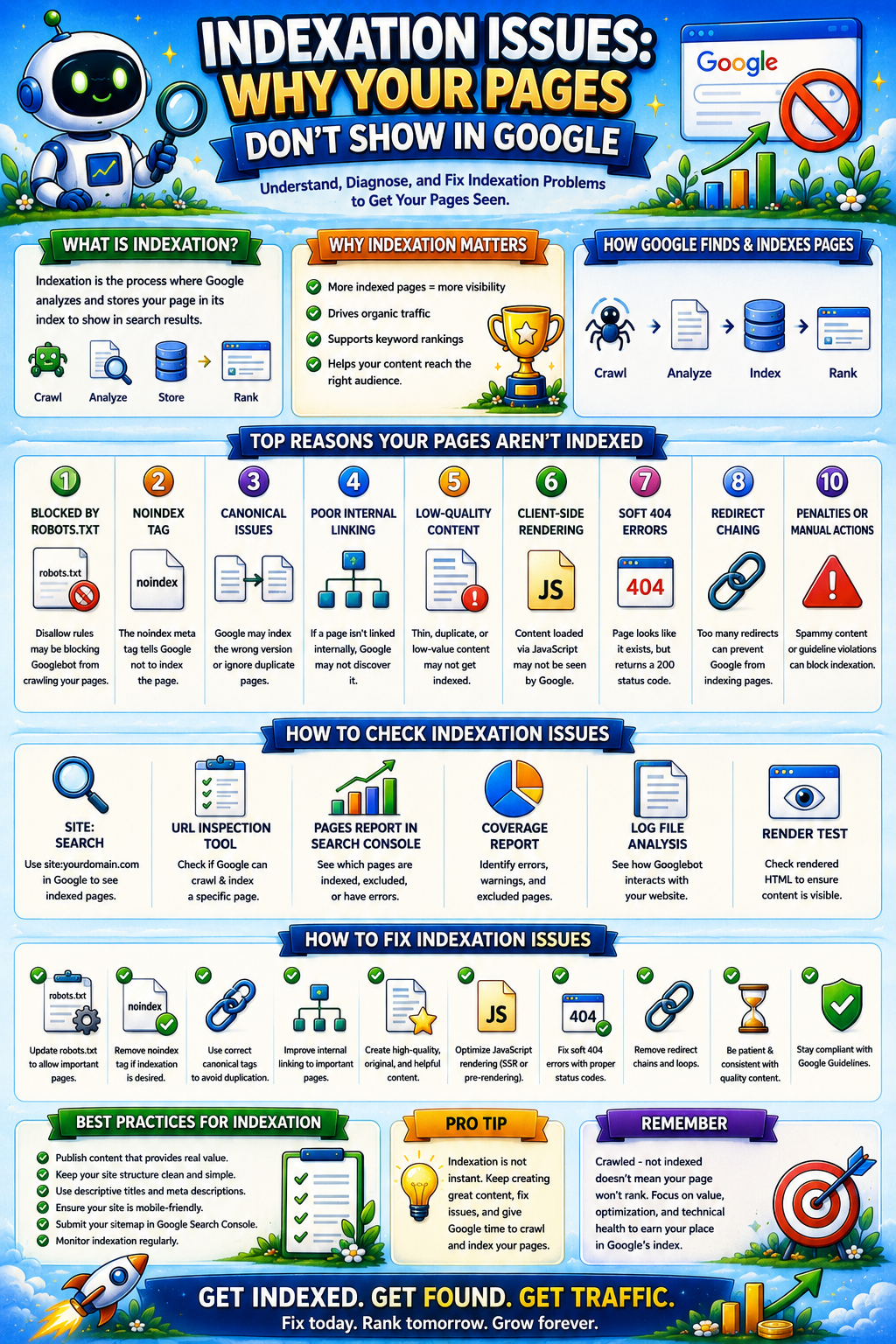
In the early days of SEO, indexation was taken for granted. You published a page, Googlebot crawled it, and it appeared in the index. In 2026, that era is officially over. As the web is flooded with trillions of AI-generated pages, Google has shifted from a “comprehensive” index to a “selective” one.
Today, indexation is a privilege, not a right. If your pages aren’t showing up, it’s not just a technical glitch; it’s a failure to meet Google’s rigorous economic and quality thresholds. This guide will dissect the 2026 indexation pipeline and show you exactly how to force Google to pay attention to your content.
1. The Economy of Crawling: Why Google “Throttles” Your Site
Google is a business, and crawling costs money. Every fetch consumes electricity, CPU cycles, and bandwidth. To understand why your pages aren’t indexed, you must first understand Crawl Budget Economics.
Crawl Capacity vs. Crawl Demand
Googlebot operates on two primary vectors:
- Crawl Capacity: This is the technical limit. If your server is slow, has a high Time to First Byte (TTFB), or returns frequent 5xx errors, Googlebot will throttle its speed to avoid crashing your site.
- Crawl Demand: This is the interest level. Does your site update frequently? Do you have high-authority backlinks? If your “Demand” is low, Googlebot won’t bother crawling your new pages, even if your server is lightning-fast.
The Reality of “Crawl Waste”
Enterprise sites often “kill” their own indexation by wasting their budget on:
- Faceted Navigation: Millions of combinations of filters (size, color, price) that create duplicate content.
- Session IDs & Parameters: Tracking codes in URLs that create infinite loops of “unique” but useless pages.
- Broken Redirects: 301 chains that lead Googlebot down a rabbit hole of wasted requests.
2. Deciphering the GSC Black Box: “Discovered” vs. “Crawled”
The Google Search Console (GSC) Page Indexing report is where most SEOs go to die. Understanding these statuses is critical for your recovery roadmap.
“Discovered – Currently Not Indexed”
This is the most common status in 2026. It means Google knows the URL exists (likely via your sitemap), but it has decided not to crawl it yet.
- The Cause: Your site lacks “Crawl Demand.” Google doesn’t think the potential value of that page justifies the cost of fetching it.
- The Fix: You don’t need technical tweaks here. You need Internal Link Equity. Move these pages closer to the homepage (1-2 clicks away) and build high-authority external links to the domain.
“Crawled – Currently Not Indexed”
This is a more serious “Quality Rejection.” Google spent the money to crawl your page, read the code, and said: “No thanks.”
- The Cause: High “Quality Threshold” failure. This usually means the content is too similar to other pages, lacks Information Gain, or triggers AI-content filters.
- The Fix: Content pruning or consolidation. If the page is “thin,” merge it with a stronger page. If it’s AI-generated, add human expert insights and unique data.
3. Technical Assassins: The Hidden Blockers
While content quality is vital, technical errors are the silent killers that stop indexation before it begins.
The Rendering Timeout (Headless Shadow)
In 2026, Google uses “Headless Chromium” to render JavaScript. However, it only waits about 5 seconds for the page to become interactive.
- If your React or Next.js app takes 6 seconds to fetch data from your API, Googlebot sees a blank loading state.
- Result: Google indexes a blank page, finds no text, and eventually drops the URL for being “Low Quality.”
Canonical Mismatch & The “Google-Selected Canonical”
The rel=”canonical” tag is now merely a suggestion. If your internal links point to Version A, but your canonical tag points to Version B, Google gets “confused.”
- The Danger: Google may choose a third, completely unrelated page as the canonical, causing your intended page to vanish from the index.
- The Fix: Ensure 100% parity between your sitemaps, internal links, and canonical tags.
4. The “Information Gain” Filter: The New Gold Standard
In the US market, competition is so high that “good” content is no longer enough. Google now uses an Information Gain Score to decide what to index.
What is Information Gain?
If your article is the 1,000th guide on “How to Bake a Cake” and it contains the same steps as the top 10 results, Google has no reason to index it. It already has that information.
- How to beat the filter: Add unique data points, original photography, expert interviews, or a controversial (but backed) take that doesn’t exist elsewhere.
- E-E-A-T in 2026: Google looks for “Proof of Experience.” If your site lacks an author with a verified digital footprint, your indexation will be throttled.
5. The Indexation Recovery Roadmap (Step-by-Step)
If you are dealing with a mass de-indexing event or a “stuck” site, follow this enterprise-grade recovery plan.
Step 1: Aggressive Content Pruning
In 2026, less is more.
- Analyze your site for “Zombie Pages” (pages with 0 traffic and 0 links).
- Delete or Noindex the bottom 30% of your site. This immediately frees up Crawl Budget and raises the “Average Quality Score” of your domain.
Step 2: Fix the “Click Depth”
Googlebot rarely crawls beyond a depth of 4-5 clicks.
- Map your site architecture. If your “Discovered” pages are 6 clicks away from the homepage, they will never be indexed.
- Use HTML Sitemaps (yes, they still work in 2026) to flatten the architecture.
Step 3: Log File Analysis
Stop guessing. Download your server logs and filter by “Googlebot.”
- Are you seeing 404 errors that aren’t in GSC?
- Is Googlebot getting stuck in a redirect loop?
- Log files are the only source of truth for understanding how the crawler behaves on your infrastructure.
Step 4: Leverage the Indexing API & IndexNow
For time-sensitive content, use the Google Indexing API (officially for jobs/broadcasts, but widely used for other types) and the IndexNow protocol. This forces a “Discovery” event, bypassing the slow sitemap-reading process.
Conclusion: Indexation is a Management Game
In 2026, the winner of the SEO game isn’t the one who publishes the most, but the one who manages their Crawl Budget and Quality Thresholds most effectively. If Google isn’t indexing you, it’s a signal that your site’s “Value-to-Cost” ratio is off.
Stop treating indexation as a given. Treat it as a luxury that must be earned through technical precision and undeniable content uniqueness.
Is your site stuck in the “Discovered” limbo? At SeoProsecco, we specialize in the high-stakes technical SEO required to break through Google’s indexation barriers.
Get a Professional Indexation Audit from SeoProsecco 🍷 and reclaim your search visibility.