


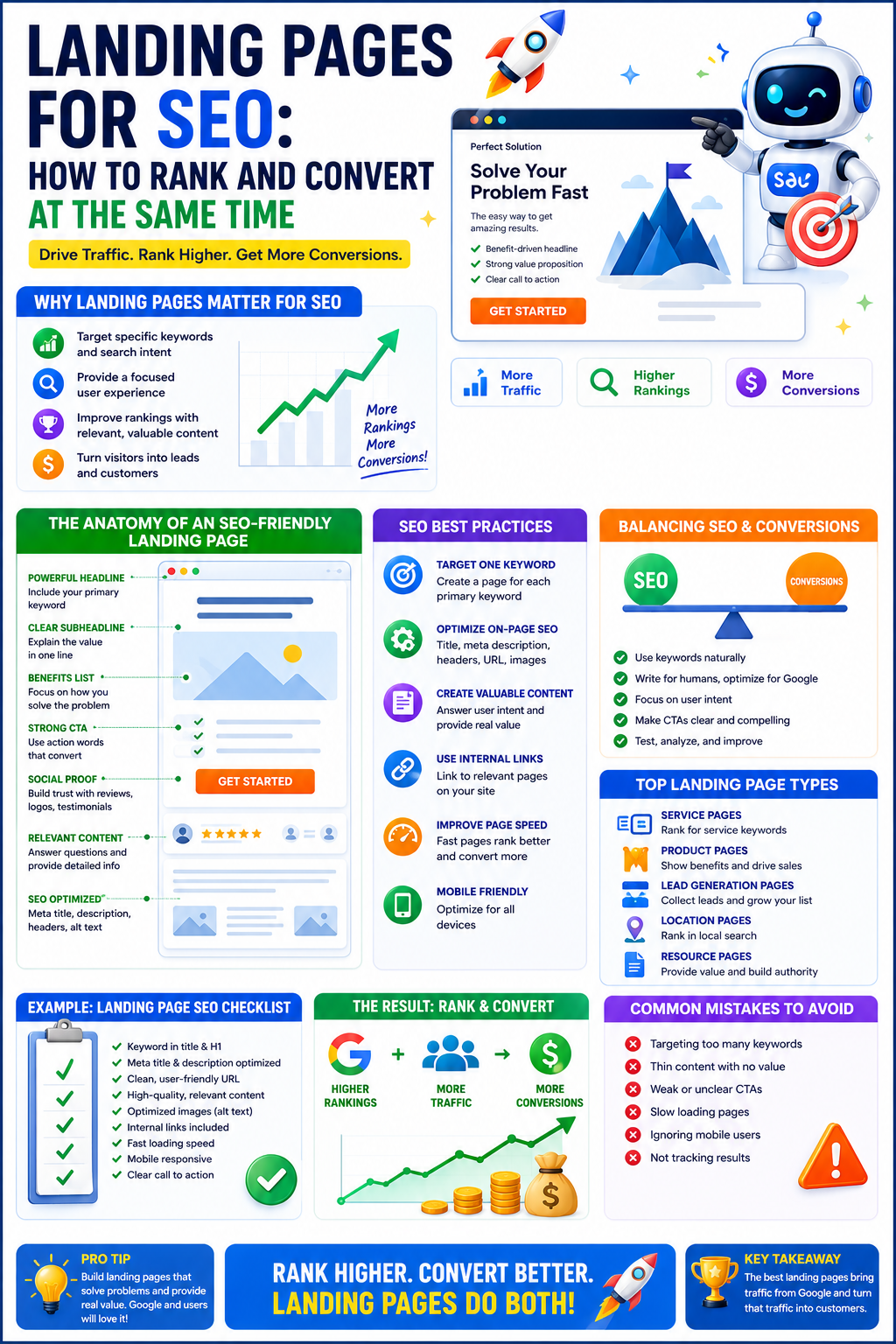
If you’ve spent any time building landing pages, you’ve probably run into a piece of advice that feels like a trap: SEO experts tell you to write long, comprehensive content with multiple headings and thorough keyword coverage. Conversion experts tell you to keep it short, focused, and free of anything that might distract a visitor from clicking the button. Try to follow both sets of advice on the same page, and you end up paralyzed — or with a page that does neither job well.
Here’s the good news: the conflict between SEO and conversion optimization is real in a few specific places, but it’s much smaller than most marketers believe. The vast majority of what makes a page rank well is also what makes it convert well, because both disciplines are ultimately rewarding the same thing — a page that clearly and quickly answers the visitor’s question.
This guide walks through exactly how to structure a landing page that does both jobs, what content length actually makes sense, which design choices help both goals at once, and where the handful of genuine trade-offs live — and how to navigate them without sacrificing either ranking or conversion.
Why Marketers Think SEO and Conversion Are at Odds
This belief has a real history, and understanding where it comes from makes it much easier to move past it.
SEO best practices that dominated the 2010s emphasized long-form content — often 1,500 words or more — because longer content historically correlated with stronger rankings across many query types. Around the same time, conversion rate optimization best practices, developed largely through PPC landing page testing, emphasized the opposite: brevity, a single call to action, and the ruthless removal of anything that might distract a visitor from converting.
Both bodies of advice were sound for the page types they were built for. The problem started when marketers applied both rulebooks to the same page without adjusting either one. A PPC landing page built for someone who already clicked an ad with a specific promise does not need 2,000 words of explanation. An SEO landing page trying to rank for a competitive keyword and convert cold organic traffic genuinely does need to answer more questions than a single paid ad’s audience would.
Here’s the key point that resolves most of the apparent conflict: Google’s ranking systems do not require a specific word count. They reward pages that comprehensively and clearly satisfy what the searcher is actually looking for — which is also precisely what drives a visitor to convert. The perceived war between SEO and CRO is largely a misunderstanding of what each discipline is actually optimizing for.
SEO Landing Pages vs. PPC Landing Pages — Know the Difference
Before applying any framework, it helps to separate two page types that often get treated identically when they shouldn’t be.
PPC and paid landing pages are built for traffic that already carries high intent and has already seen an ad making a specific promise. These pages can be short, narrow, and ruthlessly focused on a single conversion action, because the visitor arrived primed and ready. They are typically not meant to rank organically at all, and many are deliberately excluded from search indexing with a noindex tag.
SEO landing pages are built to rank for a specific keyword or keyword cluster, and to convert the traffic that organic search sends their way. These visitors have not seen an ad and have not been primed with a specific offer — they arrived with a question, and that question needs a clear, trustworthy answer before they’ll convert. This is the page type the rest of this guide focuses on, because it’s the one where the SEO-versus-conversion tension actually shows up.
The core skill here is matching page design to traffic intent and traffic temperature — not applying one rigid template to every page on your site regardless of where the visitor came from.
The Core Principle — Search Intent and Conversion Intent Are the Same Thing
This idea is the foundation for everything else in this guide, so it’s worth stating plainly: a search engine ranks a page well when it believes that page answers the searcher’s question better than competing pages. A visitor converts when they believe a page has answered their question well enough to trust the business behind it.
These are not two different jobs. They are the same job, measured by two different systems.
Take a concrete example. Someone searching “best project management software for remote teams” wants to know which tool actually fits their situation, why it’s better than the alternatives, and what it will cost them. A landing page that answers all three of those questions clearly will rank well — because it comprehensively satisfies the query — and it will convert well, because it gives the visitor everything they need to make a confident decision.
Every structural recommendation in this guide exists because it serves this shared goal. Keep this principle in mind, and most of the “SEO versus CRO” decisions that follow stop feeling like trade-offs at all.
How to Structure a Landing Page That Ranks and Converts
Here’s a section-by-section breakdown of how to build a landing page that satisfies both goals, from the top of the page to the bottom.
Above the Fold — The Make-or-Break Zone
Your headline needs to do two jobs at once: include your primary target keyword (or a close, natural variation of it) and communicate your core value proposition in language a real human would actually say out loud. Avoid headlines so stuffed with keywords they become unreadable, and avoid headlines so vague they could describe any company in your category.
Your subheadline should clarify exactly who the page is for and what makes your offer different from the alternatives. Your primary call to action should be visible without requiring the visitor to scroll. Include one supporting visual — a product screenshot, a relevant photo, or a short video — that reinforces your value proposition rather than simply decorating the page.
Here’s the part that matters most for resolving the SEO-versus-CRO tension: above-the-fold content does not need to be long to rank well. Search engines crawl and evaluate the entire page, not just the portion visible without scrolling. Keeping your above-the-fold section short and conversion-focused does not conflict with SEO in any meaningful way — this is one of the clearest examples of the supposed conflict simply not existing.
The Trust and Proof Section
Immediately below the fold, include specific, credible proof: customer logos, review scores, case study statistics, or relevant third-party certifications. This serves conversion directly, because visitors need reassurance before they’re willing to act. It also serves SEO indirectly — specific, factual content about real outcomes is exactly the kind of detail that helps a page comprehensively answer a query, and it supports the Experience, Expertise, Authoritativeness, and Trustworthiness (E-E-A-T) signals described in Google’s search quality guidelines.
The Comprehensive Answer Section — Where Length Actually Helps
This is where your page should go deeper, and it’s also where the false SEO-versus-CRO conflict mostly dissolves. Explain the underlying questions behind your target keyword thoroughly: how your product or service actually works, what specific problem it solves, how it compares to the alternatives a buyer is likely considering, and what outcomes they should realistically expect.
This section can — and usually should — be longer-form. Not for the sake of hitting a word count, but because thorough, specific answers are exactly what search engines reward and exactly what a hesitant visitor needs before they’ll convert. Use subheadings throughout so both search engines and skimming visitors can navigate the content easily. Break up dense paragraphs with bullet points, comparison tables, or short visual breaks wherever they genuinely help comprehension.
One important behavioral note: a visitor who’s already ready to convert will simply skip this section and use the call to action above the fold. A visitor who isn’t ready yet will read this section carefully and decide based on it. The page needs to serve both behaviors simultaneously — not force every single visitor through every section regardless of how ready they already are.
Objection-Handling and FAQ Section
Address the specific hesitations a real buyer actually has: price concerns, implementation difficulty, how you compare to named competitors, compatibility or integration questions. This section frequently captures “People Also Ask” placements and featured snippet opportunities, because it mirrors the exact questions people are typing into Google. It also resolves the last-mile hesitations that quietly block conversion. Structure this section as a genuine FAQ, and apply FAQ schema markup where it’s appropriate — more on this in the technical section below.
Secondary Call to Action and Final Trust Reinforcement
Close the page with one final, clear call to action, repeated trust signals (a guarantee, a closing testimonial, a risk-reversal statement), and — where relevant — a secondary, lower-commitment action for visitors who aren’t ready to convert immediately. A free resource, a newsletter signup, or a demo request all work well here, giving you a path to stay connected with visitors who needed more time.
Content Length — How Long Should an SEO Landing Page Actually Be?
This is the single most common point of confusion, so it deserves a direct answer.
There is no universal correct word count, and any guide that gives you one is oversimplifying. The right length depends entirely on the competitiveness and complexity of the query you’re targeting. A landing page targeting a simple, low-competition local service query might need only 600 to 800 words to comprehensively answer what the searcher wants to know. A landing page targeting a competitive, complex B2B software category might legitimately need 1,500 to 2,500 words to properly cover comparisons, use cases, integrations, and buyer objections.
Instead of chasing a fixed number, use this method: search your target keyword, review the top five ranking pages, and identify what questions and subtopics they all cover in common. If those competing pages thoroughly address eight distinct subtopics and your page currently addresses three, length isn’t your real problem — coverage is. Add the missing substance, and length will follow naturally.
This is also where the conversion connection becomes explicit: additional length should never be filler. Every additional section you add should remove a specific objection or answer a specific question a real buyer actually has. Content added purely to hit a word count target hurts both rankings and conversion at the same time, because it dilutes the page’s focus and increases the cognitive load on every single visitor — whether they arrived from a search result or a paid ad.
Design Choices That Help Both SEO and Conversion
These are choices that were once treated as trade-offs but are now understood to support both goals simultaneously, with no real downside on either side.
- Fast page load speed — improves Core Web Vitals, a confirmed ranking factor, and directly reduces bounce rate and cart or form abandonment, a core conversion factor. There is no version of “slow but high-converting” that wins over time.
- Mobile-first design — the majority of both organic search traffic and conversions now happen on mobile devices. A page designed mobile-first from the start serves both audiences without forcing any compromise.
- Clear visual hierarchy — well-organized headings, generous whitespace, and scannable formatting help search engines parse your content structure, and they help human visitors find the specific information they need quickly.
- Descriptive, keyword-aware subheadings — subheadings that include natural keyword variations improve both crawlability and visitor navigation. A visitor scanning for “pricing” or “how it works” benefits exactly as much as a search engine parsing the page’s structure.
- Alt text on images — improves accessibility and image search visibility, with zero conversion trade-off, since alt text is invisible to the overwhelming majority of visitors.
- Internal links to related, relevant pages — helps search engines understand your overall site structure, and helps visitors who aren’t ready to convert find their way to other useful content instead of bouncing away entirely.
Where the Real Trade-Offs Exist — And How to Resolve Them
This is the section that separates honest advice from wishful thinking, because pretending there is zero tension between SEO and conversion would be inaccurate. Here are the genuine trade-offs, and how experienced teams handle each one.
Trade-Off 1 — Page Length and Visitor Patience
A meaningful share of highly motivated visitors — often arriving from paid ads or direct referrals — want to convert immediately and find a long page genuinely frustrating to scroll through. The resolution: keep your primary call to action visible above the fold, and repeat it at intervals throughout the page, so length never blocks a fast conversion for visitors who are already ready to act. The page accommodates both behaviors instead of forcing one group to suffer for the other’s benefit.
Trade-Off 2 — Keyword Variations vs. Clear, Natural Copy
Trying to include every single keyword variation a research tool suggests will reliably make your copy read stiffly and unnaturally. The resolution: prioritize the two or three variations that genuinely sound natural in context, and let topical comprehensiveness — covering the subject thoroughly — do the rest of the SEO work. Modern search algorithms reward semantic depth and topical coverage far more than exact-match keyword repetition.
Trade-Off 3 — Pop-ups, Exit Intent, and Interstitials
Aggressive pop-ups can lift conversion rates in isolated A/B tests, but Google’s guidelines on intrusive interstitials penalize pages that block content with pop-ups, particularly on mobile devices. The resolution: use delayed, easily dismissible, or scroll-triggered prompts rather than immediate full-screen interstitials, and never block your primary content behind a pop-up on first page load.
Trade-Off 4 — Multiple Calls to Action vs. Single-Focus Conversion Design
Classic CRO wisdom says one page, one goal, one call to action. SEO landing pages that comprehensively cover a topic often naturally invite multiple plausible next steps — buy now, request a demo, download a guide. The resolution: maintain one clearly primary call to action repeated throughout the page, and treat any secondary actions as visually subordinate — smaller, less prominent, and positioned specifically for visitors who have already declined the primary action.
Technical SEO Considerations Specific to Landing Pages
Landing pages often get built outside a site’s normal content workflow — through a separate page builder, a developer-built template, or a duplicated campaign page — which means technical basics frequently get missed. Cover these before treating any landing page as finished.
- Indexability — confirm the page isn’t accidentally set to noindex, which happens surprisingly often with pages built in dedicated landing page tools or duplicated from paid campaign templates
- Canonical tags — if multiple similar versions of a landing page exist for different campaigns or A/B tests, use canonical tags to prevent duplicate content issues
- Schema markup — implement FAQ schema for your objection-handling section, and product or service schema where applicable, to improve how the page appears in search results and to support click-through rate
- URL structure — use a clean, descriptive URL that includes your target keyword, rather than an auto-generated campaign string full of tracking parameters
- Page speed and Core Web Vitals — test with PageSpeed Insights specifically; landing page builders frequently load heavy, render-blocking scripts that hurt both ranking potential and load-dependent conversion rates
How to Measure Whether Your Landing Page Is Succeeding at Both Goals
You need a simple framework to evaluate actual results, rather than guessing based on gut feel.
For SEO performance, track: organic ranking position for your target keyword, organic impressions and clicks in Google Search Console, and your organic traffic trend over time.
For conversion performance, track: conversion rate (the percentage of visitors who become leads or sales), scroll depth and time on page (to understand how much of your long-form content actually gets read), and bounce rate segmented by traffic source — since organic and paid visitors will naturally behave differently even on the exact same page.
Here’s the point worth stating explicitly: do not judge an SEO landing page’s conversion rate using PPC landing page benchmarks. Organic traffic is colder and more varied in intent than paid traffic that has already seen a specific, primed offer. A lower conversion rate on an SEO page doesn’t necessarily mean the page is failing — context and traffic source matter enormously when interpreting these numbers, and comparing across fundamentally different traffic types will lead you to the wrong conclusions.
A Simple Process for Auditing or Building Your Next Landing Page
Close out the theory with a repeatable process you can apply immediately, whether you’re building a new page or fixing an existing one.
- Identify the target keyword and research intent — search it yourself, review the top-ranking pages, and list every subtopic they cover in common
- Draft the above-the-fold section — a headline with your keyword in natural language, a clear value proposition, and a visible primary call to action
- Build the comprehensive answer section — cover every subtopic identified in step one, using subheadings and genuinely scannable formatting
- Add proof and objection-handling content — testimonials, real data, and an FAQ section addressing actual buyer hesitations
- Check technical basics — indexability, canonical tags, schema markup, page speed, and mobile rendering
- Set up tracking for both goal types — organic performance in Search Console, and conversion tracking in GA4
- Review after 60 to 90 days — SEO landing pages take meaningfully longer than PPC pages to show ranking movement; resist the urge to judge or rebuild the page too early
Conclusion and Next Steps
SEO and conversion optimization are not opposing forces on a landing page. They are two different measurement systems rewarding the exact same underlying quality: a page that clearly and thoroughly answers what the visitor actually came to find. The handful of genuine trade-offs that do exist — pop-up timing, keyword density versus natural copy, multiple calls to action — are entirely manageable with the right structure. None of them require sacrificing one goal to protect the other.
Before building anything new, audit one of your existing landing pages using the seven-step process above. Most ranking-and-conversion problems turn out to be structural issues, not reasons for a full rebuild — and a focused audit will usually show you exactly where the page is leaving either rankings or conversions on the table.
Want a landing page that ranks on Google and turns visitors into customers — without choosing between the two? Contact our team for a free landing page audit and see exactly what’s holding your page back from doing both jobs at once.