


E-E-A-T might be the most cited and least understood term in SEO. Marketers throw it around like it’s a checkbox — add an author bio, get a few backlinks, done. Then they wonder why a competitor with thinner content keeps outranking them anyway.
Here’s the correction that matters: E-E-A-T is not a ranking factor you optimize for directly. It’s an evaluation framework defined within Google’s Search Quality Rater Guidelines, applied by human quality raters — not a direct ranking factor of the Google search algorithm. Those raters don’t touch your rankings with their own hands. Rather, Google uses them the way a restaurant might use feedback cards from diners — their judgments help confirm whether Google’s automated systems are working as intended, and that feedback trains the algorithms over time.
That distinction matters more than it sounds. If E-E-A-T were a literal score, you could chase it with technical tricks. Since it’s a quality framework instead, you have to actually become more experienced, expert, authoritative, and trustworthy — and let Google’s systems notice the difference. This guide breaks down exactly what that means for each of the four components, with particular attention to “Experience,” the newest and most misunderstood letter, and to YMYL content, where the bar sits highest.
What Is E-E-A-T? A Clear, Accurate Definition
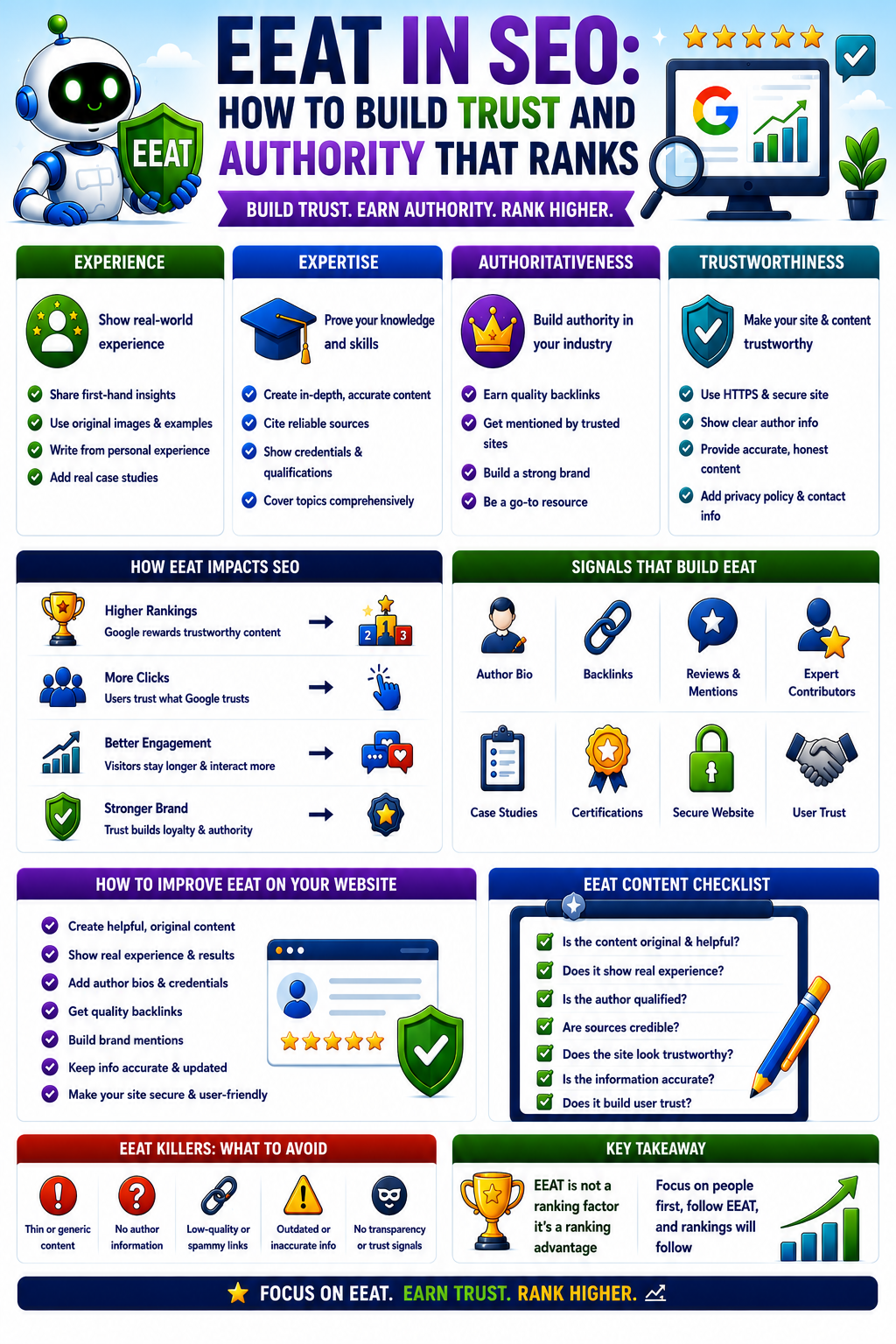
E-E-A-T stands for Experience, Expertise, Authoritativeness, and Trustworthiness. It describes how Google’s human quality raters evaluate whether a page deserves to rank.
The concept didn’t start life as a public-facing SEO term. A major inflection point came in late 2022, when Google updated its Quality Rater Guidelines to formally expand the older E-A-T framework by adding a second E: Experience. Before that, the framework had existed in various forms since 2014, evaluated by a large, distributed network of contract workers around the world who read the guidelines and rate real search results all day.
Here’s the part most explainers get wrong, and it’s worth stating as plainly as possible: E-E-A-T is not a ranking factor. There is no “E-E-A-T score” baked into the algorithm. What it actually is, is a quality compass rather than a ranking lever — a description of the qualities that genuinely helpful content tends to have, which Google’s actual ranking systems then try to detect through dozens of measurable, indirect proxies: backlink quality, author transparency, content depth, site reputation, and more. SEO-Kreativ
The practical implication follows directly from this. You cannot install E-E-A-T with a meta tag or a piece of schema markup. You build it by making your content and your site genuinely more experienced, expert, authoritative, and trustworthy, and trusting that the signals show up downstream.
Why Google Added “Experience” — The Newest Letter
This section gets the most space in this guide because it’s the component readers consistently misunderstand or skip entirely.
Expertise and Experience sound similar but measure different things. Expertise is formal knowledge or qualification — a credential, a degree, years in a field. Experience asks whether the author or site has firsthand involvement with the topic — whether they actually used the product, stayed at the hotel, went through the medical treatment, or performed the task they’re describing.
Google didn’t add this to devalue expertise. The goal was to acknowledge that theory alone does not always satisfy what a searcher actually wants. A few forces pushed this change. Many searches are better served by firsthand insight than by academic explanation — a traveler wants tips from someone who has actually been to the destination, not a synthesized overview. And Experience helps counterbalance AI-generated content specifically: AI can synthesize information at scale, but it cannot produce genuine lived experience, which gives an edge to human-led, original work over generic summaries.
Use this clarifying example: a travel writer with a journalism degree has expertise in writing. A travel writer who actually stayed at the hotel they’re reviewing has experience. The strongest content typically has both — and the gap between content that merely sounds informed and content that demonstrably comes from someone who was there is exactly what this component is built to surface.
Building Experience — Practical Ways to Demonstrate Firsthand Involvement
This is the hardest of the four components to fake convincingly, which is also why it rewards genuine effort more than any technical shortcut.
- Original photos and video — genuine, original images of the product, location, or process under discussion, rather than stock photography. Clear author bios, original photos or videos, and documented processes all help signal that content comes from lived involvement, not just research.
- Specific, granular detail that only comes from direct experience — exact measurements, particular outcomes, small details a secondhand researcher would be unlikely to know or think to include
- First-person narrative where it’s earned — phrases like “when we tested this” or “during our stay” that clearly indicate direct involvement, rather than generic third-person description that could apply to any competitor’s product
- Author bios that state firsthand experience explicitly — not “passionate writer,” but “spent six years working in commercial kitchens before reviewing restaurant equipment”
- Original data or informal testing results — independently gathered information demonstrates direct engagement that purely aggregated, secondhand content can’t replicate
One honest caveat: Experience is also the hardest component for Google’s systems to verify directly, simply because it’s harder to fabricate convincingly than a credential or a backlink. That difficulty is precisely the point — specific, hard-to-fake detail carries more weight here than in any other pillar.
Building Expertise — Demonstrating Real Knowledge and Qualification
- Author credentials displayed clearly and accurately — relevant degrees, certifications, licenses, or professional history on a visible bio, not buried three clicks deep
- Content depth that reflects genuine subject knowledge — covering nuance, edge cases, and the reasoning behind a recommendation, not just the surface-level facts a quick search would surface
- Accurate, well-sourced information — citing primary sources, official guidance, or peer-reviewed research, particularly for anything in YMYL territory
- Visibly maintaining and updating older content — content freshness has become one of the more significant ranking-correlated signals; pages updated within the past year have shown measurable ranking gains in recent analysis, and updating content openly (a “last reviewed” date, refreshed statistics) demonstrates ongoing expertise rather than a one-time publishing effort
- Subject-matter experts reviewing or co-authoring content — especially for YMYL topics, having a genuinely qualified expert review or approve content adds a layer of credibility a general content writer can’t replicate alone
Building Authoritativeness — Earning Recognition as a Go-To Source
Authoritativeness isn’t about your personal qualifications — that’s Expertise. It’s about whether your site or brand is recognized, by other reputable sources, as a trusted reference on the topic.
- Backlinks from genuinely relevant, reputable sources — a few strong, relevant links matter more than many weak ones; poor-quality or irrelevant links can actually dilute authority rather than strengthen it
- Brand mentions across the web, linked or unlinked — mentions on authoritative platforms, whether linked or not, reinforce reputation, and Google’s systems are increasingly capable of recognizing unlinked citations as a signal in their own right
- Consistent topical focus over time — a site that comprehensively covers one specific area builds authority there far faster than one publishing broadly across unrelated subjects
- Recognition from other established voices — speaking at industry events, publishing original research or proprietary data, and building a recognizable brand entity Google can understand all compound this signal over time
- Structured knowledge presence — a legitimate, well-sourced listing in structured knowledge bases can reinforce authority, though this should never be pursued through manipulation
Building Trustworthiness — The Foundation Beneath the Other Three
Google’s own people-first content guidance is explicit on this point: of the four components, trust is the most important. Even highly experienced, expert, authoritative content fails its actual purpose if a reader can’t trust it to be accurate, honest, and safe — and recent core update analysis backs this up directly: Google has at times demoted highly credentialed publishers in favor of the primary sources those publishers cited, elevating institutions closer to the original source of truth over secondhand expert commentary. Trust at the source level can outweigh credentials alone.
- Transparent, accurate “About” and contact information — who runs the site, how to reach them, and what the organization actually is, stated plainly rather than buried
- Clear disclosure of sponsorships, affiliate relationships, and conflicts of interest — undisclosed financial relationships are one of the fastest ways to undercut every other trust signal you’ve built
- Accurate, fact-checked content with visible correction history — particularly non-negotiable for YMYL topics, where a factual error carries real-world consequences
- Secure site infrastructure — HTTPS, secure checkout, and a visible, genuine privacy policy are baseline expectations that low-quality sites routinely skip
- Genuine reviews presented honestly, including responses to negative ones — a curated, artificially perfect reputation reads as less trustworthy than an honest one with visible engagement
- Visible editorial standards — a published correction policy or fact-checking process signals institutional trustworthiness that extends beyond any single article
Why YMYL Content Faces a Higher E-E-A-T Bar
YMYL — Your Money or Your Life — describes topic categories where inaccurate information could carry real, potentially harmful consequences for a person’s health, financial stability, or safety, or for the welfare of society more broadly. This traditionally covers medical information, financial advice, legal guidance, and major life decisions — and as of the most recent guideline update, it now explicitly extends to government, civics, and society topics that affect public trust in institutions and processes, a direct response to growing concern about disinformation in politically sensitive areas.
The practical implication is straightforward: raters apply very high page-quality standards specifically because of the potential real-world harm of getting it wrong, and that elevated bar shows up downstream in how those judgments train the ranking systems. A factual slip in a recipe blog is a minor inconvenience. The same slip in medical or financial content can cause genuine harm — and Google’s quality framework is built to treat those two situations very differently.
If your business operates anywhere in YMYL territory, the practical takeaway is to invest disproportionately in everything covered above: visible credentials, expert review, careful sourcing, and transparent ownership. The bar here isn’t marginally higher. It’s intentionally, structurally higher.
A Practical E-E-A-T Self-Audit Framework
Run this audit on your highest-traffic, highest-value pages first — they carry the most ranking and reputational weight — before expanding it sitewide.
Experience: Does the content include original photos, first-person detail, or clear evidence of direct involvement with the topic? Are author bios specific about relevant firsthand experience, rather than generic?
Expertise: Are author credentials visible and accurate? Does the content reflect depth beyond what a quick search would surface? Is older content actually reviewed and updated, or just left to age?
Authoritativeness: Are backlinks coming from genuinely relevant, reputable sources, or from low-relevance volume plays? Is the site recognized or mentioned by other established voices in the space? Does the site maintain a consistent topical focus?
Trustworthiness: Is ownership and contact information clear and accurate? Are affiliate relationships and sponsorships disclosed plainly? Is the site secure, and are reviews presented honestly, including the negative ones?
Common E-E-A-T Mistakes to Avoid
- Treating E-E-A-T as a literal score to “optimize” — there’s no markup or meta tag that signals it directly; it has to be built through genuine practice
- Adding a generic author bio without specific credentials — “passionate content writer” signals nothing; a bio listing actual relevant experience does the real work
- Skipping Experience because it feels intangible — it’s the most commonly neglected of the four components, despite being demonstrable with original photos, granular detail, and honest first-person framing
- Applying the same editorial bar to YMYL and low-stakes content — under-investing in exactly the area facing the highest scrutiny
- Chasing backlink volume without relevance — a handful of links from genuinely respected, topically relevant sources outperforms a large pile of irrelevant ones
- Leaving business transparency information vague or missing — a thin or absent “About” page is a quiet but real trust signal failure
- Treating E-E-A-T as a one-time project — content accuracy, credentials, and reputation all require ongoing maintenance, not a single audit-and-edit cycle
Conclusion and Next Steps
E-E-A-T isn’t an algorithm to game. It’s an evaluation framework — built for human quality raters, not a direct input into the ranking algorithm — describing the genuine qualities Google’s systems are designed to detect and reward over time: Experience, Expertise, Authoritativeness, and above all, Trustworthiness. Building it takes real editorial and reputational investment across your content, your author presentation, your site structure, and your standing beyond your own site. There’s no shortcut that substitutes for the real thing.
Start with the self-audit above, focusing first on your highest-value pages and any YMYL content where the bar is highest. Most sites find their real gaps concentrated in a few fixable places — author transparency, content depth, or sourcing — rather than needing a full overhaul.
Not sure if your content meets the E-E-A-T bar Google is looking for? Contact our team for a free E-E-A-T audit and find out exactly where your site’s trust and authority signals need strengthening.