


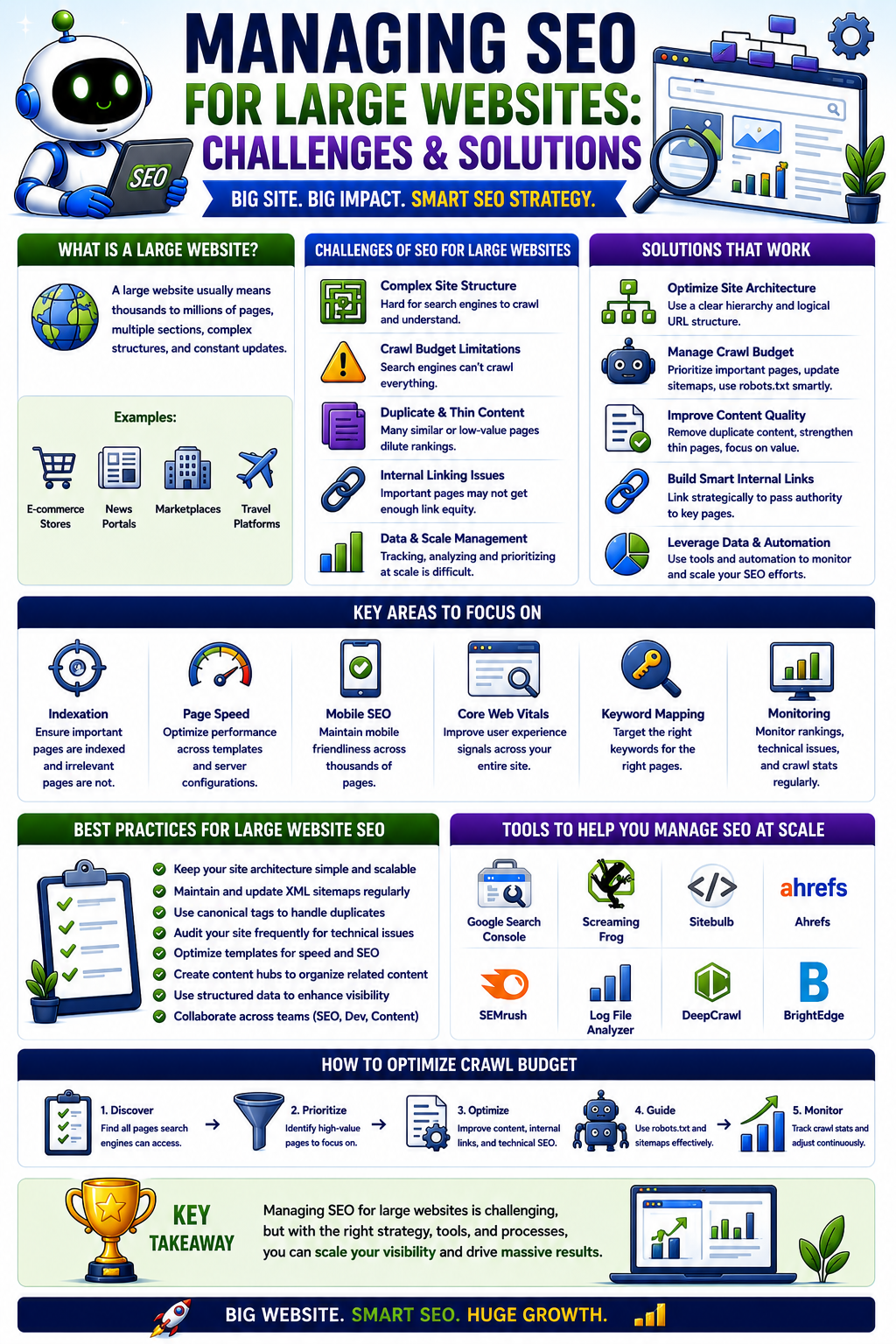
Here is the advice most SEO content gives large-site teams: fix your canonical tags, clean up your redirect chains, optimize your crawl budget, improve your internal linking. All of it technically correct. Almost none of it addressing the actual reason those fixes haven’t happened yet.
At enterprise scale, the hardest SEO problems are rarely the technical ones. Most experienced SEO leads at large organizations know exactly what needs to be fixed. The problem is that a canonical tag fix requires a developer, the developer’s team is three sprints deep into a revenue-generating feature, the product manager doesn’t see “canonical cleanup” as a business priority, and the engineering lead has never heard of the SEO director until this email landed in their inbox. The fix sits in the backlog for four months and eventually gets deprioritized entirely.
This is what large-site SEO actually looks like in practice — and it’s why managing SEO for large websites is a genuinely distinct discipline, not a bigger version of standard SEO. Technical expertise matters. Organizational fluency matters more. This guide covers both: the technical challenges that only become real at scale, and the organizational, governance, and stakeholder challenges that most SEO content ignores entirely — despite them being the actual reason most enterprise SEO programs underperform.
Why Large-Site SEO Is a Different Discipline, Not Just a Bigger Version
On a small or medium-sized site, the person responsible for SEO typically has direct access to the CMS, can make content changes themselves, can request a developer fix and have it live within days, and is often the same person making the final call on the site’s structure and technical setup. The feedback loop between identifying a problem and implementing the solution is tight.
At enterprise scale, every one of those conditions reverses. The CMS is likely a platform shared across dozens of teams, each with their own publishing workflows and governance rules. A technical fix requires a product requirement document, stakeholder sign-off, engineering estimation, sprint prioritization, QA, and a staged rollout — a process measured in weeks or months, not hours. Content decisions involve legal review, brand compliance, regional adaptation, and sign-off from multiple stakeholders who may have competing priorities. And “the person responsible for SEO” is often a team or function that influences decisions made by people in other departments who don’t report to them, don’t have SEO in their job description, and are measured on metrics that have nothing to do with organic search.
This isn’t a complaint about enterprise organizations. It’s a description of how they necessarily work at scale. The practical implication for SEO is clear: enterprise SEO requires a fundamentally different operating model — one built around influence, governance, and coalition-building, not just technical expertise and implementation speed. Recognizing this distinction is the prerequisite for doing the work well.
Technical Challenges Unique to Large Websites
That said, the technical challenges are real and worth treating seriously. Several problems that are theoretical or minor on smaller sites become genuine, ongoing operational concerns at scale.
Crawl Efficiency at Scale
On a small site, Google finds and crawls every meaningful page with minimal effort. On a large site with tens of thousands to millions of URLs, how efficiently Googlebot allocates its crawl attention becomes a real engineering concern. Faceted navigation — the filtering systems common in e-commerce that allow users to filter by color, size, price, and combinations thereof — can generate near-infinite crawlable URL paths from a small set of underlying product templates. Internal site search results, session parameters, and tracking parameters compound this further.
The practical consequence is that Googlebot can spend a significant portion of its crawl activity on low-value, near-duplicate parameter URLs rather than on the product pages, category pages, and content a business actually wants ranking. Solving this requires coordinated technical work: robots.txt exclusions for low-value parameter patterns, canonical tag implementation across large template sets, and ongoing monitoring of crawl activity distribution rather than a one-time fix.
Content Cannibalization Across Thousands of Similar Pages
A product catalog with 50,000 SKUs, a publisher with ten years of article archives, or a SaaS help center with hundreds of overlapping support articles all face the same problem: many pages targeting closely related or overlapping queries, competing against each other rather than against external results for the queries that matter. At small scale, cannibalization is a manageable audit exercise. At large scale, it becomes a continuous operational challenge requiring systematic identification, a clear consolidation or differentiation strategy, and consistent editorial governance to prevent new cannibalization from appearing as fast as old instances are resolved.
International and Multilingual Architecture
Organizations operating across multiple countries or languages face compounding technical complexity. Hreflang implementation — the attribute that tells Google which language or regional version of a page to serve to which audience — is straightforward in concept and error-prone in practice at scale, particularly when regional teams update URLs, page structures, or content without updating the corresponding hreflang annotations across related pages. Decisions about site structure (ccTLDs versus subdirectories versus subdomains for international content) carry long-term SEO consequences that are very difficult to undo once established, and these decisions are frequently made by teams without meaningful SEO input.
Legacy URL Structures and Migration Debt
Large, long-established sites accumulate technical debt in ways smaller sites simply don’t. A platform migration in 2016 might have left redirect chains that have never been collapsed. A product line discontinued in 2019 might have generated thousands of orphaned URLs still receiving crawl attention. A rebrand in 2021 might have introduced URL pattern inconsistencies that persist across sections of the site today. Each instance is individually fixable. Collectively, they represent a sustained background drain on crawl efficiency and index clarity that requires a structured, prioritized remediation plan rather than ad hoc repairs.
Site Architecture and Internal Linking at Scale
On a large site with multiple competing content hierarchies — product pages, category pages, editorial content, support documentation, landing pages — ensuring that link equity flows appropriately to the pages with the highest business value requires deliberate, ongoing management. New content gets published without links from existing high-authority pages. Category hierarchies get restructured without updating internal links to reflect the new relationships. Important pages end up reachable only through long click-depth paths because the site’s navigation has evolved without a coherent linking strategy.
Core Web Vitals Across Diverse Page Templates
Large sites typically run multiple distinct page templates, each with different performance characteristics, third-party script loads, and image handling approaches. Improving Core Web Vitals cannot be solved with a single fix — it requires template-by-template performance work across every major page type, and performance regressions introduced by new features or third-party integrations require ongoing monitoring to catch before they propagate across thousands of pages.
The Organizational Challenges Most SEO Content Ignores
Technical challenges at enterprise scale are solvable with the right expertise and sufficient engineering capacity. The organizational challenges are harder precisely because they can’t be fixed with code — they require sustained influence, relationship-building, and structural changes to how SEO integrates with the rest of the organization.
Getting SEO Fixes Prioritized in the Engineering Backlog
This is, for most enterprise SEO leaders, the most persistent and most frustrating challenge in the discipline. Engineering capacity at large organizations is always oversubscribed. SEO fixes compete directly against revenue-generating features, customer-facing improvements, infrastructure requirements, and security work, all of which have clearer and more immediate business cases in the language engineering leadership and product managers actually use.
The fix that works — consistently, across organizations and industries — is translating technical SEO issues into business impact language before the prioritization conversation happens. A redirect chain issue described as “multiple redirect hops violating best practices” sits in the backlog indefinitely. The same issue described as “we estimate this redirect structure is adding 300ms of load time to our top 200 landing pages, which our CRO team’s data suggests costs us approximately 8% in conversion rate on pages generating $180,000 in monthly organic revenue” gets scheduled. The technical fact is identical. The business case is what actually moves engineering prioritization.
Building this kind of quantified business case requires collaboration with analytics, finance, and the commercial teams who can validate or refine the revenue estimates — which means the relationships that make SEO prioritization possible need to be built before there’s an urgent fix to push through, not at the moment of crisis.
SEO Without Direct Authority Over Other Teams
In virtually every large organization, SEO does not have direct authority over the teams whose decisions most affect organic search performance — engineering, content, product, regional marketing. The discipline runs almost entirely on influence, and influence at enterprise scale is built slowly and spent carefully.
The practical approaches that actually work in this environment are worth naming directly. Embedding SEO requirements into existing processes — product requirements documents, content briefs, technical design reviews — is dramatically more effective than requesting separate “SEO projects” that sit outside the teams’ normal workflows and compete for attention they don’t have. Identifying and cultivating internal champions within engineering and product teams — people who understand the value of organic search and can advocate for SEO considerations in their own internal conversations — extends SEO’s reach beyond what any single SEO function can accomplish through direct engagement alone. And securing executive sponsorship — an SVP or VP who will escalate SEO prioritization when it stalls — is often the difference between a well-understood SEO program that consistently gets deprioritized and one that gets the resources it actually needs.
Maintaining Governance Across Distributed Teams, Brands, or Regions
Large organizations are not monolithic. Regional marketing teams, acquired brands, multiple product lines, and separate business units may all be publishing content, making technical changes, and launching new pages with varying degrees of coordination with central SEO. Without governance, technical SEO standards erode inconsistently and unpredictably — one region follows canonical best practices while another has been creating duplicate content at scale for months without anyone noticing.
The failure mode to avoid is attempting to control this centrally in a way that creates a bottleneck — requiring every piece of content or every technical change to pass through a central SEO review adds latency that large organizations simply cannot absorb. The more sustainable model is setting clear, documented standards that distributed teams can follow independently, with lightweight review checkpoints for the specific categories of change that carry the most SEO risk: platform migrations, new market launches, significant restructuring of navigation or URL patterns, and large-scale content initiatives.
Communicating SEO Performance and ROI to Leadership
Enterprise SEO teams are often required to justify their existence and budget quarterly, to executives who are primarily accountable for revenue outcomes and who may not have a clear mental model of what organic search actually contributes. The same principles that apply to building CEO-ready dashboards apply here, with the added complexity of aggregating performance across multiple sites, brands, or regions into a single coherent narrative. Organic revenue and lead contribution from search are the metrics that survive executive scrutiny. Rankings and traffic volume, presented without a clear connection to business outcomes, rarely do.
Building an SEO Governance Framework for Large Organizations
The organizational challenges described above share a common root: the absence of a deliberate, documented structure for how SEO standards get set, communicated, and maintained across a complex organization. A governance framework doesn’t eliminate organizational friction — but it reduces the surface area for preventable errors and makes it easier to recover when they happen anyway.
Centralized Standards, Federated Execution
The model that works most reliably at enterprise scale keeps a central SEO function responsible for setting technical standards, creating documentation, running the review process for high-risk changes, and monitoring cross-organizational performance. Individual teams, brands, or regions retain execution autonomy within those standards. This avoids the bottleneck of total centralization and the inconsistency of total decentralization, and it respects the organizational reality that distributed teams cannot and will not wait for central SEO approval on every piece of content or every minor technical change.
Living Documentation as Organizational Infrastructure
Standards that exist only in a shared drive folder that nobody opens are not standards — they’re aspirations. Effective SEO governance at scale requires documentation that is genuinely accessible, regularly updated, and built into the workflows people actually use: content brief templates that include SEO requirements, technical design review checklists that include SEO considerations, new hire onboarding that covers URL structure and linking standards before someone publishes their first piece of content.
Lightweight Review for High-Risk Changes
Not every change needs SEO review. But a small category of changes — platform migrations, international expansion, significant navigation restructuring, large-scale content consolidation or deletion — carries enough SEO risk that a required, lightweight review checkpoint before execution is worth the coordination cost. The emphasis on “lightweight” is important: a review process that adds significant latency to every major initiative will be routed around rather than used.
Regular Cross-Team Communication
Recurring, structured communication between a central SEO function and distributed teams — quarterly syncs with regional marketing leads, participation in product roadmap planning sessions, a standing agenda item in content team meetings — catches emerging issues before they become significant problems and reinforces standards without requiring constant top-down enforcement.
Resourcing SEO for Large Organizations
Under-resourcing SEO at enterprise scale is common and consistently costly. A single generalist SEO hire managing a site of genuine enterprise complexity will inevitably deprioritize either the technical work or the organizational work — and usually both, in favor of whoever is asking most urgently at any given moment.
A dedicated technical SEO resource — someone with engineering-adjacent skills, capable of working directly with development teams in their own technical language — becomes necessary rather than optional once a site crosses the complexity threshold described in this guide. Generalist content-focused SEO experience does not translate to the template-level performance work, crawl analysis, or hreflang implementation that large sites genuinely require.
The build-versus-partner decision deserves honesty rather than a generic recommendation. Most large organizations benefit from a hybrid model: in-house SEO owning strategy, governance, stakeholder relationships, and the organizational work described in this guide, with specialized external support handling surge capacity during major migrations, deep technical audits requiring skills or tooling not available in-house, and specialized project work that falls outside the permanent team’s bandwidth. Neither a fully in-house nor a fully outsourced model works as well as a hybrid at enterprise scale — the organizational dimension of this work genuinely requires someone who understands the internal politics and relationships, while some technical depth genuinely benefits from external specialization.
A Practical Prioritization Framework for Large-Site SEO Work
When everything competes for limited engineering and team capacity, a consistent method for deciding what to push for first is worth more than any individual technical fix.
Score potential SEO initiatives across three dimensions before bringing them to a prioritization conversation:
Estimated business impact — translated into traffic, revenue, or lead estimates wherever the data supports it, not technical severity alone. An issue affecting 200 high-traffic pages with clear revenue attribution ranks differently than an issue affecting 200 orphaned pages nobody visits.
Implementation complexity — how many teams genuinely need to be involved, how much engineering effort is realistically required, and whether this is a template-level change that fixes thousands of pages at once or a page-by-page remediation exercise.
Organizational urgency — whether the issue is actively worsening (a redirect chain growing longer with each new migration), tied to a specific upcoming event (a platform launch, a new market entry), or stable enough to wait for a more favorable prioritization window.
The highest-value targets in any backlog are issues that score high on estimated business impact and low or medium on implementation complexity. These are the items worth investing the political and coordination capital to prioritize, because they offer the clearest return for the organizational effort required to get them shipped.
Conclusion
Managing SEO for large websites is not a technical discipline that happens to involve a lot of pages. It’s an organizational discipline that also requires deep technical expertise — and the organizational dimension is where most enterprise SEO programs actually succeed or fail. The technical problems described in this guide are solvable with the right expertise and sufficient engineering capacity. The organizational problems — prioritization, influence without authority, governance across distributed teams, ROI communication to skeptical executives — require sustained structural investment and political fluency that generalist SEO advice rarely addresses.
Start wherever the gap is widest. If the technical challenges described here feel unaddressed, that’s the immediate priority — the organizational work can’t fix what the technical foundation hasn’t built. If the technical foundation is reasonably sound but the organizational and governance challenges feel painfully familiar, invest in structure and process there first: a governance framework, documented standards, and executive sponsorship that gives SEO the organizational leverage it needs to get work done at this scale.
Managing SEO at enterprise scale takes more than generalist SEO knowledge — it takes experience with the technical and organizational complexity that only shows up at scale. Contact our team for a free enterprise SEO assessment and get a clear, realistic plan for your specific site and organization.